
Food and restaurants
Tenerife at the table
13,678 bars, cafés and restaurants, one for every 71 residents, yet Canarians spend less on eating out than people in almost any other region of Spain. What Canarian cooking really is, where the other cuisines came from, who eats where, what arrives by ship, what a menú del día and a waiter cost, why Adeje has five times more restaurants per head than Santa Cruz, and what makes a guachinche real.
21 min read · 23 sources · Updated October 2026
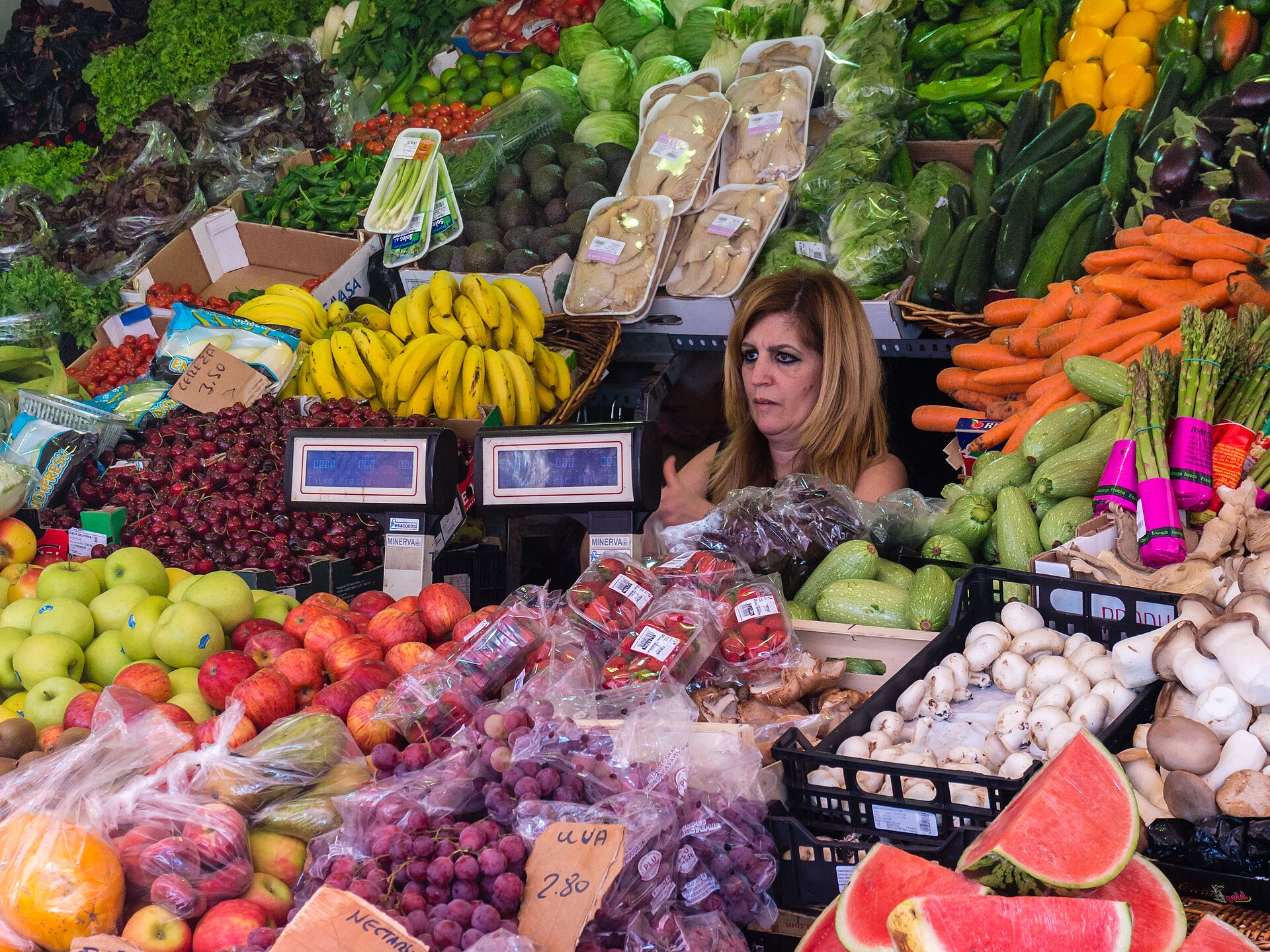
Fruit stall at the Mercado de Nuestra Señora de África, Santa Cruz · Tuxyso, CC BY-SA 3.0
In short
- The Cabildo's register lists 13,678 bars, cafés and restaurants on Tenerife: one for every 71 residents, and in Adeje one restaurant for every 72.1,2
- Canarians spend 951 euros a year per person on eating out, against 1,125 in Spain as a whole; only the Balearics spend less. On Tenerife, visitors spend more in restaurants than residents do.3,4
- The menú del día in the Canaries is the cheapest in Spain, at 13.50 euros, while most of the food on the plate arrives by ship: barely 9 to 17% of the fish eaten in the islands is caught locally.5,11
- Only 47 venues are registered as guachinches selling their own wine. The 11 places in the register with "guachinche" in their name are all, legally, ordinary bars and restaurants.1,7
What Canarian cooking really is
Canarian food is island cooking born of scarcity: few ingredients, cooked simply, and a sauce to make them sing. Its pillars are potatoes, gofio, fish, goat, pork and the mojos, the raw sauces of garlic, oil, vinegar, cumin and peppers, red (picón) or green with coriander or parsley.
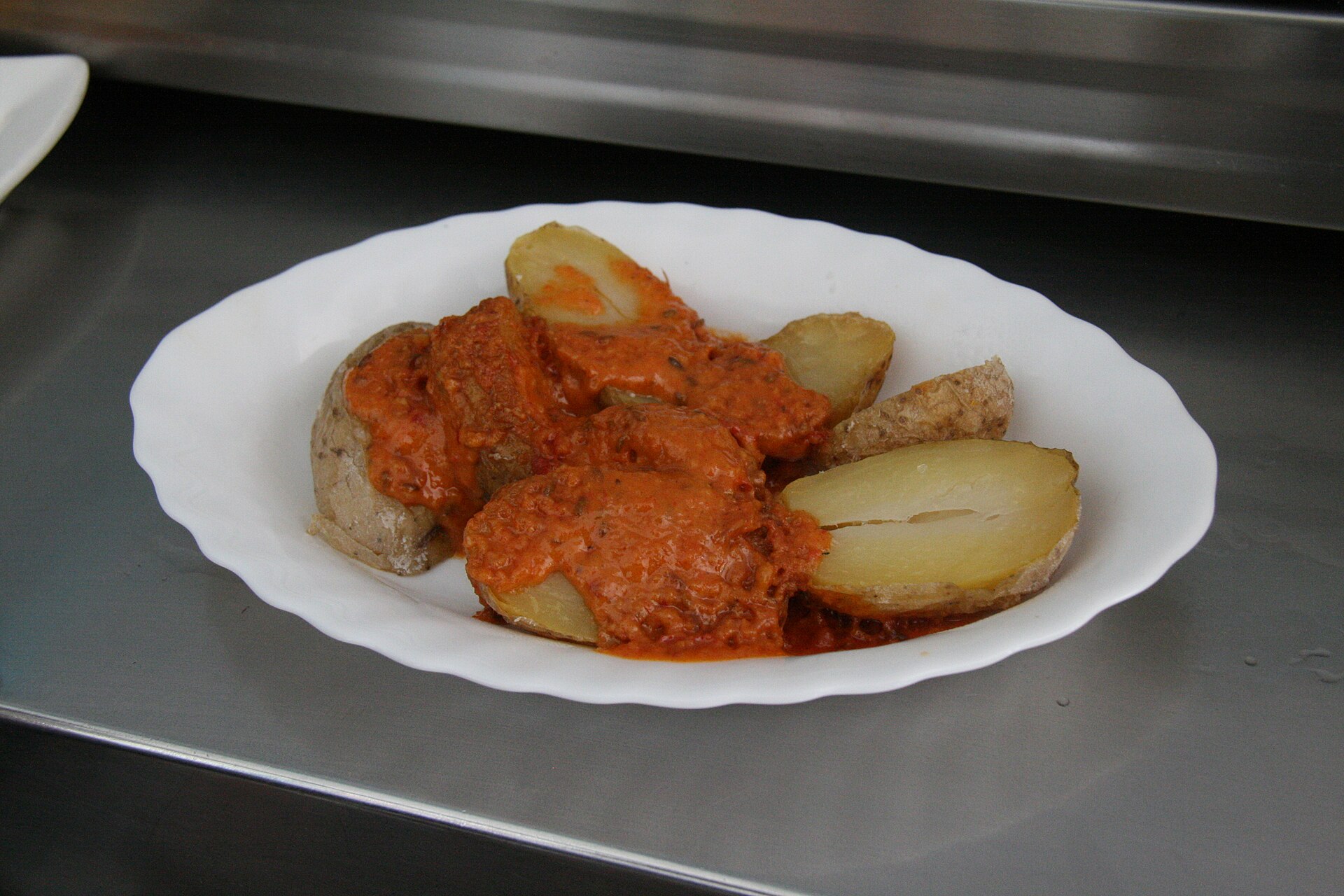
- Papas arrugadas: small potatoes boiled in very salty water until the skin wrinkles and turns white with salt. The old varieties brought from the Andes in the sixteenth and seventeenth centuries are protected as Papas Antiguas de Canarias, the first potato in Spain with a protected designation of origin.20
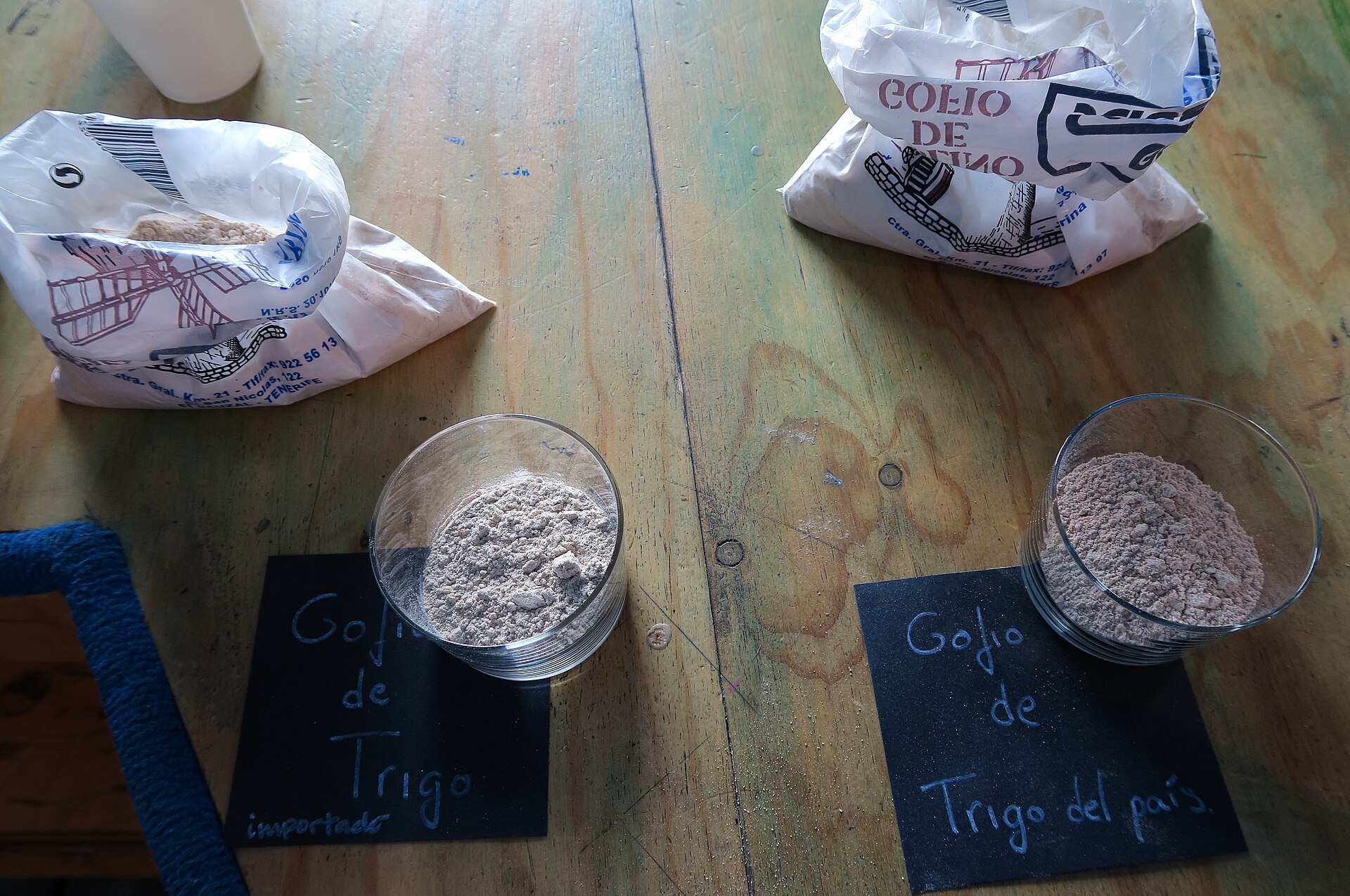
- Gofio: flour of toasted cereal, wheat, maize or barley, inherited from the islands' pre-Hispanic population. It thickens soups, becomes escaldón when stirred into fish or meat broth, is kneaded with water into pella and turns up in desserts. It is a protected geographical indication.20
- Fish and meat: vieja (parrotfish), cherne, sama and abadejo from the fishing villages, sancocho of salted fish with potatoes and mojo, conejo en salmorejo (rabbit marinated in garlic, wine and paprika), carne de cabra, carne fiesta (marinated fried pork) and the puchero, a stew of meat, chickpeas and vegetables.
- Cheese, honey and wine: soft and cured goat's cheeses, Miel de Tenerife with a protected designation, and wines from five Tenerife designations of origin (Tacoronte-Acentejo, Valle de La Orotava, Ycoden-Daute-Isora, Valle de Güímar and Abona) plus the regional DOP Islas Canarias, which on its own has about 50 wineries and more than 800 growers.20,22
- Sweet things: bienmesabe of almonds, frangollo, truchas at Christmas and the barraquito, Tenerife's layered coffee with condensed milk, liqueur, cinnamon and lemon peel.
The other kitchens, and where they came from
Tenerife's restaurant map follows its migrations. The Cabildo register does not record what a venue serves, but the trade names give a rough picture: about 180 places have pizza or pizzeria in their name, around 70 kebab, about 50 refer to India or a tandoori, about 50 to China, some 25 to sushi and a dozen to Venezuela.1 (Our search of the names. The real numbers are higher, because most places have names that say nothing about the menu.)
- Venezuela. For a century Venezuela was where Canarians emigrated, and when its crisis sent tens of thousands back, they brought the arepa with them. The register lists 35 areperas as a category of their own, and 60,000 people born in Venezuela live on the island (see our article on who lives on Tenerife).1,18
- Italy. Italians are the largest foreign community on Tenerife, and it shows in the 137 venues registered as pizzerias and many more Italian restaurants registered simply as restaurants, especially in the south.1
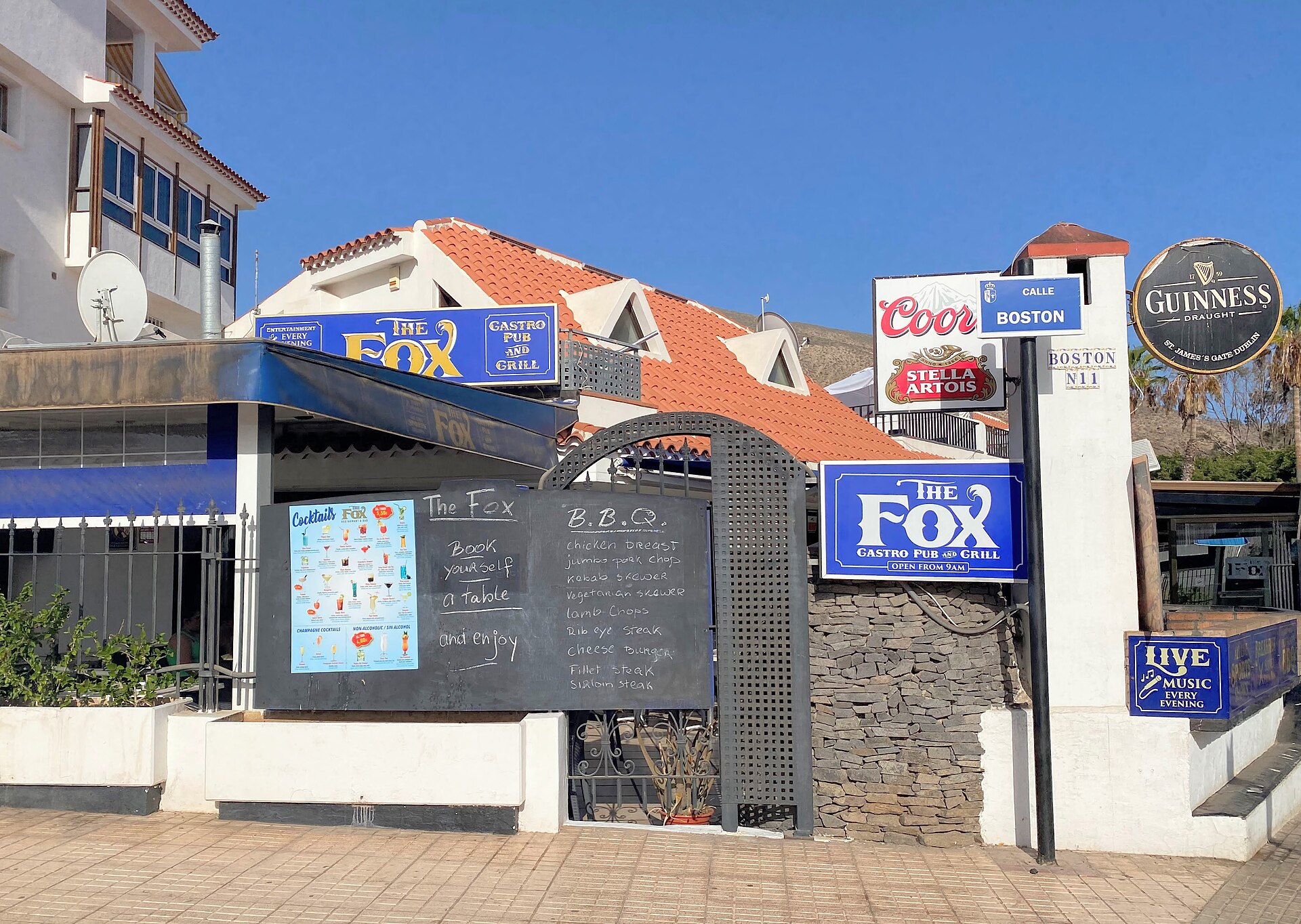
- Britain and Ireland. Pubs, Sunday roasts and full breakfasts follow the British tourist and the British resident, mostly in Los Cristianos, Las Américas and Costa Adeje.
- Asia. Chinese, Indian, Japanese and Thai kitchens are spread across the island; Indian restaurants in particular have become a fixture of the tourist resorts.
Do Canarians eat out?
Less than you might think. In 2025 the average Canary Islander spent 951 euros on restaurants and bars, against 1,125 euros in Spain as a whole, 15% less. Of Spain's seventeen regions, only the Balearic Islands spent less (911 euros); the Basque Country spent 1,617.3
That is not a cultural refusal to go out: total spending per person in the Canaries is 10% below the national average, and the islands have Spain's lowest wages (see Housing in numbers). But eating out is one of the first things to give. Restaurants take 7.5% of a Canarian household's budget, against 8.0% in Spain; for every euro spent eating out, Canarians spend 2.07 euros on food at home, Spaniards overall 1.88.3 (Ratios are our calculation from the INE figures.)
The other side of the counter is the visitor. Tourists spent 1,126 million euros in Tenerife's restaurants, cafés and bars in 2025, 13% more than a year earlier: 174.80 euros per trip, or 22.27 euros a day.4 Applying the Canarian average to Tenerife's 966,469 residents gives roughly 920 million euros a year. Visitors spend more in the island's restaurants than the people who live here. (Our estimate: it uses the regional average and counts residents' meals eaten off the island, so treat it as an order of magnitude.)
Yet only 37% of tourists reported any restaurant spending in the island's survey, and 18.9% booked all-inclusive, down from previous years. A large share of tourists still eat mostly in their hotel.4
What locals love and what visitors order
The two clienteles barely overlap. Visitors order papas arrugadas, grilled fish and paella on seafront terraces in the south, where a third of all seats are outdoors, twice the share in the north and the metropolitan area.1
Locals follow other routes:
- the north on weekends: guachinches and grill houses in Tacoronte, La Matanza, La Victoria, Santa Úrsula and La Orotava, where 34 of the island's 47 registered guachinches are;1
- tascas and bars in Santa Cruz and La Laguna: 79 of the island's 188 tascas are in Santa Cruz (44) and La Laguna (35);1
- fishing villages for fish of the day: Tajao, El Médano, Las Caletillas, Punta Hidalgo, San Andrés, Alcalá;
- the weekday menú del día, starter, main, dessert and drink for 13.50 euros on average.5
North, south, east, west and the hills
Each part of Tenerife eats differently. To measure it, we grouped the municipalities into five areas and counted what the Cabildo register holds in each; the highlands, which cut across municipal boundaries, we measured by the addresses along the mountain roads.1,2 (Our grouping and calculation from the Cabildo register and the 2025 census. Signals taken from trade names are rough, since most names say nothing about the menu.)
- South (Adeje, Arona, San Miguel and Granadilla): every cuisine in the world, with Canarian food in the minority. 4,945 venues for 223,081 residents, 22.2 per 1,000, one eatery for every 111 residents; in Adeje one for every 72. A third of all seats are on terraces. Names pointing to foreign cuisines (Italian, Indian, Chinese, British, Mexican and others) are twice as common as in the north (7.5% against 3.5%), and names pointing to Canarian food barely a third as common. Seven of the island's nine Michelin-starred restaurants are here.14
- West (Guía de Isora and Santiago del Teide): the same model on a smaller scale. 666 venues for 35,502 residents, 18.8 per 1,000, one eatery for every 119 residents, and the same share of foreign-sounding names as the south (7.4%). Los Gigantes, Puerto de Santiago, Playa San Juan and Alcalá mix resort restaurants with fish by the harbour; at the top end, M.B at Abama holds two Michelin stars.14
- North (from Tacoronte to Buenavista): tradition and guachinches. 3,325 venues for 233,078 residents, 14.3 per 1,000, one eatery for every 189 residents. 34 of the 47 registered guachinches are here, and names pointing to Canarian food (tasca, bodega, casa, guanche, mojo and the like) are three times as common as in the south (9.9% against 3.3%). Puerto de la Cruz, the island's first tourist town, is the exception, with 30 venues per 1,000 residents.
- East (Candelaria, Arafo, Güímar, Fasnia and Arico): the fish coast. 721 venues for 69,910 residents, 10.3 per 1,000. People come here for the catch of the day: Candelaria, Las Caletillas, El Puertito de Güímar, El Porís and Tajao, and 6 of the island's 16 venues with cofradía (fishermen's guild) in their name are on this coast.1
- Santa Cruz and La Laguna: an island of bars. 3,976 venues for 402,966 residents in the metropolitan area (with El Rosario and Tegueste), 9.9 per 1,000, one eatery for every 368 residents; in Santa Cruz one for every 395. 71% of the venues are bars and cafés: breakfast, coffee and a beer on the way home rather than dinner out. Almost half of the island's tascas (89 of 188) are here.
- The hills: meat, wood fires and fewer customers. About 166 venues line the mountain roads (La Esperanza, Las Cañadas and Aguamansa, Taucho and Ifonche, Chío, Arguayo and Erjos) and Vilaflor. 54% of them are restaurants, against 34% island-wide, and only 8% of their seats are outdoors, against 25%. These are grill houses and roadside restaurants for grilled meat, rabbit, goat and stews, smaller and quieter, busy with families at weekend lunchtimes and with hikers and Teide visitors. (Our search of the addresses; it misses venues whose address does not name the road.)
Guachinches: the real thing and the imitations
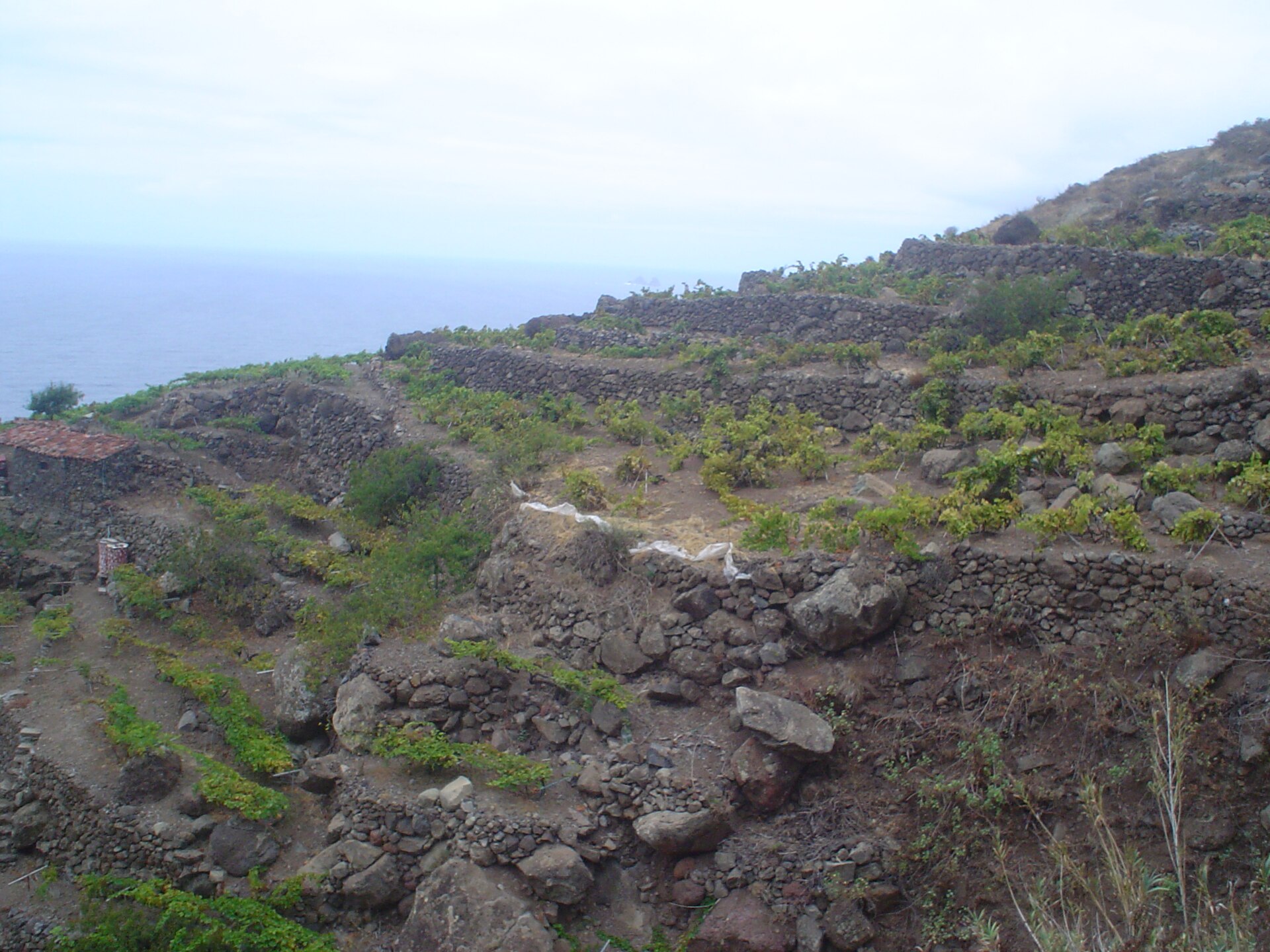
A guachinche was originally a winegrower's garage or cellar where, after the harvest, a family sold off its surplus wine and served a few homemade dishes to go with it. The Canary Islands government regulated them in 2013 (Decree 83/2013) and the rules are strict:7
- the wine must come from the owner's own vineyards and be made by the owner; buying wine from a winery does not count;
- they can open for four months a year at most, and must close when the wine runs out;
- they can serve up to three different cooked dishes, plus local fruit, nuts and pickles;
- they can serve only their own wine and water: no beer, no soft drinks;
- they must display a plaque by the entrance with a bunch of grapes, a "V" on a wine-coloured background and the words "Vino de cosecha propia", and notify the Cabildo every year when they open and close.
Since the 2019 Canary food quality law, the name "guachinche" is reserved for these places.7 In 2018 the regional government counted 157 registered guachinches on Tenerife, against four on Gran Canaria and two on El Hierro.8 The Cabildo register now lists 47 under the own-harvest wine category.1 Meanwhile, the 11 venues in the same register with "guachinche" in their trade name, from Adeje to Santa Cruz, are all registered as ordinary bars or restaurants.1 Many popular "guachinches" are, legally, restaurants with a rustic look, which is not a crime as long as they do not use the name.
The 47 registered guachinches
As of 28 October 2026 (register last updated by the Cabildo on 30 September 2026), these are all the venues the Cabildo register lists under the own-harvest wine category, with the address they registered, from the north to the south.1 Treat it as a map, not a timetable: a guachinche opens only while its wine lasts, at most four months a year, and the register does not say which ones are open this season, so ask locally or call before you drive up. A place missing from the list may have registered after the last update, or may legally be a restaurant.
- La Orotava (10): Ale y José (Urb. Camino de Chasna, 33); Casa Estela (C/ La Hondura, 35); Casa Lala (Ctra. General de La Perdoma, 131); El Laurel (Ctra. General de La Perdoma, 19); El Molinero (C/ Los Salesianos, 20); El Morreta (C/ Las Medianías, 30); La Chaotera (Camino El Pino, 118); La Marzagana (C/ Montserrat de Estany Cabrera, 13); Ramón (Camino de Los Gómez Trasera, 40); Vicente La Fuente (C/ La Punta, 197).
- Santa Úrsula (8): Ca' Lorenzo (C/ El Cantillo, 31); Don Trino (Ctra. Antigua Corujera, 15); El Rinconero (Ctra. Nueva La Corujera, 47C); La Brevera (C/ Las Turcas, 12); La Rampa (Ctra. Nueva La Corujera, 129); Nino (C/ Tosca La Iglesia, 147); Quintero (C/ La Cepa, 1); Suso el Pintor (C/ Guanches, 75).
- La Victoria de Acentejo (6): Casa Adolfo (C/ Los Arroyos, 84); Casa José (C/ La Puente, 7); Casa Pepe (C/ Pedro Hernández, 80); Casiano (C/ La Puente, 26); La Cuadra (C/ Marrero, 3); Los Felipes (C/ San Antonio, 61).
- Los Realejos (6): Casa Evelio (C/ 25 de Julio, 19); Casa Milagros (C/ El Brezal, 87); El Brezal (C/ El Brezal, 120); La Cuadra (C/ La Trinidad, 18); Los Caballos (Camino El Lagar Viejo, 34, El Mocán); M Chela (C/ Transversal El Granadillar, s/n).
- Tacoronte (3): Bodega Don Tomás (C/ Valerio José Padrón, 15); La Gorgolana (C/ Las Toscas, 40); Nino (C/ La Higuera, 27, next to the Red Cross).
- El Sauzal (1): Bodega Zenón (Ctra. General del Norte, 97, El Montillo).
- La Laguna (3): Bethel (La Cañada del Rosario, 21 A); El Borgoñón de Sandra (Camino La Costa, 4); La Casona de Montijo (C/ Montijos, 30).
- El Rosario (2): Bodega La Hijuela (Camino El Agua, s/n); El Mosquito (C/ Maximino Bacallado Rodríguez, 16C).
- Candelaria (2): Casa Manuel (C/ Jeba); El Escobón (Morra de Jeba, Las Cuevecitas, s/n).
- Arafo (1): Finca Agrícola Km2KCero (Camino La Choza, 1).
- Güímar (1): Finca El Salón (Camino Los Llanos, 26).
- Guía de Isora (3): Abreu (C/ Villanueva, 97); La Pacheca (C/ Norte, 19); Leti (C/ Cueva La Teja, s/n).
- Granadilla de Abona (1): El Pinalete (Paraje La Fuente, El Pinalete).
The business in numbers
How big it is. The register counts 4,455 restaurants, 4,707 bars, 2,533 bar-cafés, 1,007 cafés, 188 tascas and 137 pizzerias, among others, with more than 547,000 declared seats, more than one for every two residents (and only two thirds of venues declare their seats).1 The register is administrative: some closed venues may linger in it.
How many jobs. At the end of 2025, 39,175 people were registered with Social Security in food and beverage services on Tenerife: 9.6% of all jobs on the island and more than in hotels and other accommodation (31,655). Restaurants gained 690 jobs in 2025; bars lost 535 (-4.4%).4 The trend is from the corner bar towards the restaurant.
What it pays. Under the provincial collective agreement, from July 2026 a waiter's base salary is 1,320.04 euros a month, a cook's 1,307.24 and a head chef's 1,514.51, in fourteen payments a year.16
How much there is to earn. Adding tourists' 1,126 million to residents' roughly 920 million gives a market of around 2,000 million euros a year: about 150,000 euros of revenue per venue and 52,000 euros per worker. A waiter's base salary over fourteen payments, plus roughly a third more in employer's social security, comes to about 24,000 euros: close to half of the average revenue per worker, before food, rent, energy or a single euro of profit. (Our calculation from the sources above; tips, extras and seasonal staff change the picture for each business.) Restaurants in the Canaries do have one advantage over the mainland: they charge 7% IGIC instead of 10% VAT.17
Who owns it. Overwhelmingly, small owners: self-employed people and family companies with one or two venues. The big chains are a thin layer. The 18 national and international fast-food and coffee brands we looked for (McDonald's, Burger King, KFC, Telepizza, Starbucks, 100 Montaditos and others) add up to 91 entries out of 13,678, under 1%.1 (Our search of trade names.) The third player is the hotel: all-inclusive buffets compete directly with the restaurants outside, and at the top end most of the island's Michelin stars shine inside five-star resorts.14
How fast it turns over. There is no public statistic on how long restaurants survive on Tenerife, nor on their owners' nationalities. What is visible is the traspaso: businesses are sold as going concerns, with furniture, kitchen and clientele, for a key-money payment on top of the rent, and "se traspasa" signs are a permanent feature of the south. The pandemic showed how fragile the margins are: in the twelve months to April 2021, 623 hospitality businesses closed on Tenerife.21
What grows here and what comes by ship
The Canary Islands import most of what they eat. A team at the University of La Laguna calculated that, depending on how local processing is counted, 73 to 87% of the protein and 84 to 93% of the fat in the average Canarian diet comes from imported food.9 Researchers at the same university put imports at more than 80% of the food consumed and the islands' reserves at about a week in case of disruption.10
Fish is the great paradox. Surrounded by the Atlantic, the archipelago catches only 9 to 17% of the fresh and frozen fish it eats, while it exports most of its tuna (about 85%). Canarian households eat about 5 kg of fresh fish per person a year at home, half the Spanish average.11 Much of the "fish of the day" is imported or farmed.
Fruit and vegetables are the island's strength. Of the 80 million kilos traded at Mercatenerife, the island's wholesale market, in 2023, 44% was local, and 58% of the vegetables.13 Bananas, tomatoes, avocados, mangoes, papayas, peppers, potatoes, goat's cheese, honey and wine can all be local and fresh.
Potatoes show the pressure. The area planted in the Canaries fell by about 37% between 2013 and 2023; on Tenerife, from 2,711 to 2,257 hectares. Imports arrive from the United Kingdom, Cyprus, Egypt and, since 2025, Israel, sold in bags labelled "para arrugar". In August 2026, imported potatoes cost 1.80 euros a kilo in a supermarket, against 2.72 euros for local ones.12
What is mostly imported: cereals and flour (even much of the gofio is milled from imported grain), beef, most pork and poultry, most milk and dairy, rice, pulses, oil and most fish. The EU helps cover the extra transport cost of essential foods and animal feed through the Specific Supply Arrangement (REA), with a budget of about 62 million euros a year.19
Prices: island versus mainland
- Eating out is cheaper. The average menú del día in the Canaries costs 13.50 euros in 2026, the lowest in Spain together with Murcia, against a national average of 14.70 and 16.30 in the Basque Country.5
- The shopping basket is about the national average in Santa Cruz. In the 2025 OCU consumer study, the annual basket cost 6,154.14 euros in Santa Cruz de Tenerife against a Spanish average of 6,259, while Las Palmas de Gran Canaria, at 6,513.57, was among the most expensive cities in Spain. In Santa Cruz the difference between the cheapest and the most expensive supermarket was 1,623.44 euros a year.6
- Tax helps. Basic foods (bread, milk, eggs, flour, fruit, vegetables, pulses, oil and, since 2025, gofio) pay 0% IGIC, where the mainland charges 4 or 10% VAT.17
- But local is not always cheaper. Local potatoes cost half as much again as imported ones.12 Local farmers and livestock breeders have long complained that the REA, which lowers the cost of shipping in milk, cheese and other basics from the rest of the EU, makes it harder for them to compete.19,23
Stars
The 2026 Michelin guide gives Tenerife nine starred restaurants with eleven stars out of fifteen starred restaurants in the Canaries. El Rincón de Juan Carlos (Adeje) and M.B (Guía de Isora) have two stars; Donaire, Haydée by Víctor Suárez, Il Bocconcino, Nub and San-Hô in Adeje, Taste 1973 in Playa de las Américas and El Taller Seve Díaz in Puerto de la Cruz have one. Haydée recovered its star and El Taller Seve Díaz is new; the islands lost none.14,15
Adeje alone has six starred restaurants and seven stars, one star for every 7,230 residents. (Our calculation.) Only one of the nine, in Puerto de la Cruz, is in the north.
So what kind of market is it?
Tenerife is two restaurant markets sharing one island. The first lives off visitors: dense, sunny, terrace-heavy and multilingual, concentrated along the south and west coasts, where restaurants compete with all-inclusive buffets and with each other, and where the island's Michelin stars sit inside five-star resorts. The second lives off residents: bars, tascas, grill houses and guachinches in the north and the metropolitan area, with customers on Spain's lowest wages and a 13.50-euro menú del día as the benchmark. Both stand on the same foundations: a low entry barrier, thousands of small owners, wages that eat half of the revenue per worker, ingredients that mostly arrive by ship and a steady stream of traspasos. For diners it is a paradise of choice and price. For those who run the restaurants, it is a business of thin margins where the location decides almost everything.
Food and restaurants in numbers
13,678
bars, cafés and restaurants on the Cabildo register, one for every 71 residents.1
951 €
a year per person spent eating out in the Canaries, against 1,125 € in Spain.3
1,126 M€
spent by tourists in Tenerife's restaurants and cafés in 2025.4
13.50 €
average menú del día in the Canaries, the cheapest in Spain.5
9-17%
of the fish eaten in the Canaries is caught locally.11
Common myths
Myth
Canarians practically live in restaurants.
Myth
The fish on a Tenerife menu was caught off the island.
Fact
Only 9-17% of the fish eaten in the Canaries is caught locally; much of it is imported or farmed.11
Myth
Any place with "guachinche" on the sign is a guachinche.
What to do
- To spot a real guachinche, look for the plaque by the door (a bunch of grapes and a "V" on a wine-coloured background, "Vino de cosecha propia"), a short menu and only wine and water to drink.
- Ask what the fish of the day is and whether it was caught locally: vieja, cherne, sama or bocinegro are good signs.
- For local potatoes, look for "papas del país" or "papas antiguas"; the bags labelled "para arrugar" are often imported.
- Eat the menú del día on weekdays in Santa Cruz, La Laguna and the industrial estates for the best value on the island.
- If you plan to take over a restaurant, check that the activity licence and the terrace permit can be transferred, ask for proof that there are no debts with suppliers or Social Security, and budget staff costs with the provincial hospitality agreement's pay tables.
Notes and sources
- 1.Cabildo de Tenerife, open data portal, Establecimientos de hostelería y restauración de Tenerife (register of 13,678 establishments by municipality, type, name and declared seats), updated 30 September 2026. Counts, groupings and name searches are our own. datos.tenerife.es
- 2.Instituto Canario de Estadística (ISTAC), population according to the municipal registers, dataset E30243A_000002, Tenerife municipalities, 2025. istac
- 3.Instituto Nacional de Estadística (INE), Encuesta de Presupuestos Familiares 2025, average spending per person by region and spending subgroup (tables 73991 and 73992: "Restauración", "Productos alimenticios", total). ine.es
- 4.Turismo de Tenerife, Balance de situación turística de Tenerife 2025 (tourist spending on restaurants, cafés and similar; board basis; Social Security affiliations in food and beverage services, December 2025). webtenerife.com
- 5.José Antonio Felipe, "El menú del día más barato de España está en Canarias", Diario de Avisos, 22 October 2026 (Hostelería de España and Edenred study). diariodeavisos.elespanol.com
- 6.Alberto Ley, "Las Palmas paga más por la cesta de la compra que Santa Cruz: más de 350 euros de diferencia", Atlántico Hoy, 25 September 2025 (OCU supermarket study 2025). atlanticohoy.com
- 7.Juan Carlos Pérez, "Muchos lo llaman guachinche, pero la ley dice otra cosa: cómo reconocer uno auténtico", Diario de Avisos, 18 October 2026 (Decree 83/2013, Decree 147/2013 and Law 6/2019 on agri-food quality). diariodeavisos.elespanol.com
- 8.EFE, "Acuerdo para aumentar el periodo de apertura de los guachinches", Diario de Avisos, 18 July 2018 (157 guachinches registered on Tenerife, according to the regional minister of agriculture Narvay Quintero). diariodeavisos.elespanol.com
- 9.Dirk Godenau, Gloria Martín-Rodríguez, José Ignacio González-Gómez and José Juan Cáceres-Hernández, "Food consumption in the Canary Islands: nutritional implications of food imports and local production", BMC Public Health 22, 2022 (data 2013-2017). doi.org
- 10.Universidad de La Laguna, I Jornadas sobre justicia y soberanía alimentaria: incidencia en la salud pública de Canarias, 2019 (presentation). ull.es
- 11.José J. Pascual Fernández (ISTUR, Universidad de La Laguna), presentation for the MarketAC project, 2025 (9-17% self-sufficiency in fish; about 85% of tuna exported); Universidad de La Laguna, "La ULL fomenta el consumo de pescado local en sus comedores", 2022 (local share 10-15%; 5 kg of fresh fish per person at home in 2021). marketac.eu · ull.es
- 12.Román Delgado, "Los importadores descubren un nuevo plato de cocina canaria: papas de Israel arrugadas y con mojo", elDiario.es / Canarias Ahora, 5 August 2026 (ISTAC potato area 2013-2023, supermarket prices). eldiario.es
- 13.Mercasa, "Mercatenerife celebra su 50 aniversario con un homenaje a las producciones locales", November 2024 (volume traded in 2023 and local share). mercasa.es
- 14.Guía MICHELIN, "Todos los restaurantes con Estrellas MICHELIN en España 2026", November 2025. guide.michelin.com
- 15.Javier Suárez, "Luces, sombras y reflexiones que nos deja la Guía Michelin 2026", elDiario.es / Canarias Ahora, 27 November 2025. eldiario.es
- 16.Convenio colectivo de hostelería de la provincia de Santa Cruz de Tenerife 2025-2028 (BOP no. 154, 22 December 2025; tables corrected in BOP no. 4, 9 January 2026; revision of the restaurant tables in BOP no. 108, 9 September 2026), as summarised by Turnozo. turnozo.com
- 17.Guía Fiscal, "IGIC de Canarias 2026: tipos impositivos"; Garrigues, "Canarias introducen modificaciones en el IGIC y el IRPF con efectos 2025" (gofio at the zero rate). guiafiscal.es · garrigues.com
- 18.Teneriffa News, "Arepas: Venezuelan corn cakes in the Canary Islands"; Diario de Avisos, "Los mejores sitios donde comer arepas en Tenerife", February 2023. teneriffa-news.com · diariodeavisos.elespanol.com
- 19.Tenerife Weekly, "The Government of the Canary Islands approves modifications in the REA to cover the 62 million annual budget", 12 February 2024. tenerifeweekly.com
- 20.Universidad de La Laguna, "De la cocina a los libros" (Canarian foods with quality labels: Papas Antiguas de Canarias DOP, Gofio Canario IGP, Miel de Tenerife DOP, cheeses and wines); PotatoPro, "Representantes políticos y del sector agrícola presentan la DO Papas Antiguas de Canarias", 2013. ull.es · potatopro.com
- 21.Diario de Avisos, "Más de 1.200 comercios y locales de hostelería han cerrado en Tenerife", April 2021 (figures given by the Cabildo). diariodeavisos.elespanol.com
- 22.Vinetur, "La DOP Islas Canarias presenta su plan estratégico", 21 March 2025. vinetur.com
- 23.Interempresas, "El Gobierno quiere dejar de subvencionar el queso y la leche que viene a Canarias desde países de la UE", 2016 (local producers' complaints about subsidised imports). interempresas.net
Keep reading
Water
Tenerife drinks from inside the volcano
Sewage
What goes into the sea
Housing
Housing in numbers
Politics
Who governs the Canaries, and what comes next
Teide
How to legally stand on top of Teide
Volcano
The volcano under watch
Traffic
TF-5: anatomy of a traffic jam

Shopping
Why a parcel from Madrid can cost more than one from China
Population
Who lives on Tenerife
Hotels
Who owns Tenerife's hotels
Economy
What Tenerife lives on

Weather
Tenerife's weather, floor by floor