
Teide
How to legally stand on top of Teide
The cable car stops 160 metres short of the summit, and that last stretch needs a permit, a time slot and, from 2026, a fee for anyone not from Tenerife. The rules, the prices, the three legal ways up, and why 130 people had to be evacuated one weekend.
7 min read · 7 sources · Updated October 2026
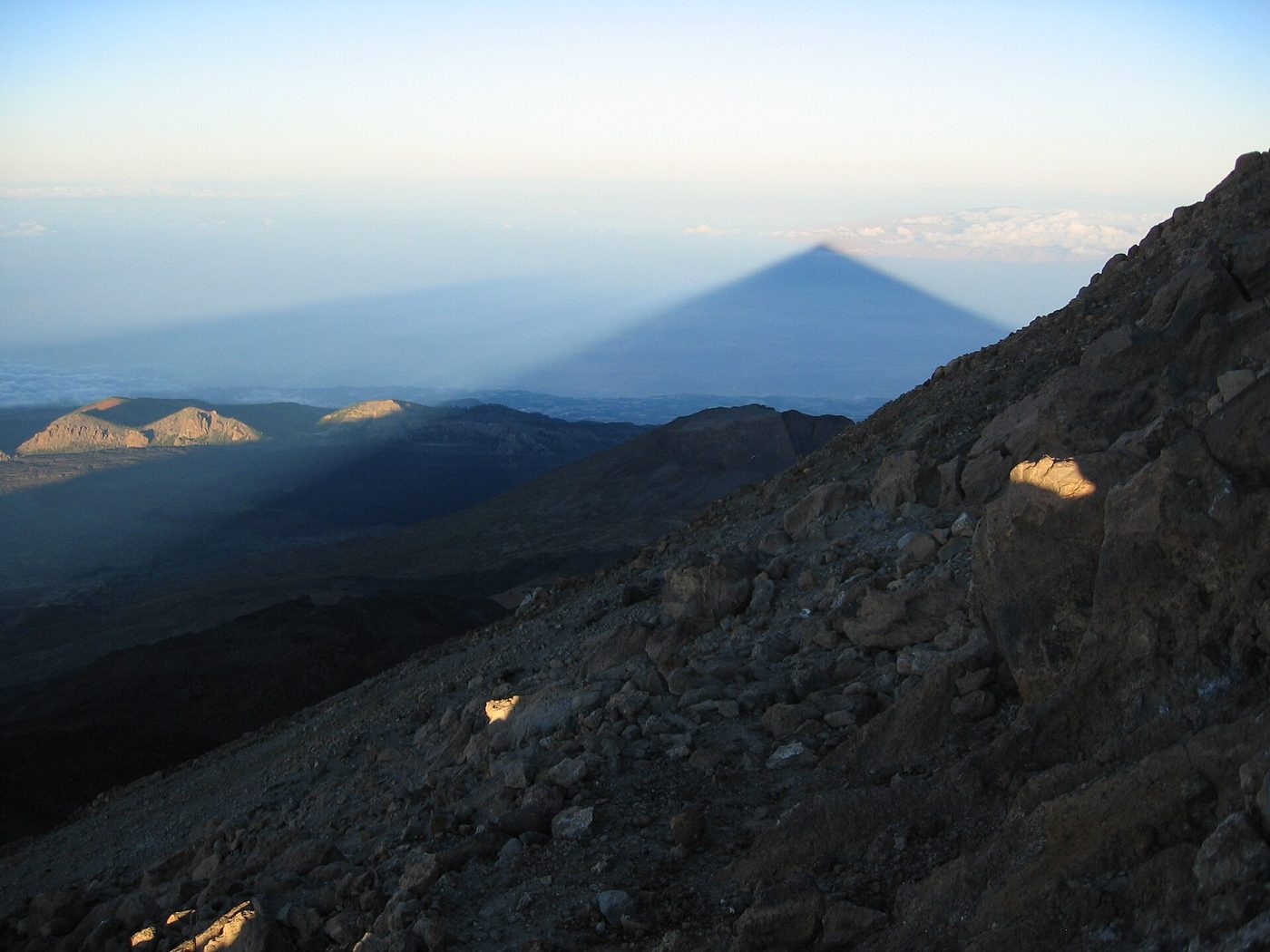
Teide's shadow at sunrise · Dr.michi, CC BY-SA 3.0
In short
- The summit of Teide (3,715 m) is reached by a short trail, Telesforo Bravo (PNT 10), from the cable car's upper station at 3,555 m. You need a free or paid permit booked on Tenerife ON.1,2
- From 2026 the permit is free for Tenerife residents and under-14s, 6 € for other Canary Islands residents and 15 € for everyone else; places open every Monday at 07:00, 56 days ahead.2,3
- The cable car ticket does not include the permit. The only way up without a separate day permit is to sleep at the Altavista refuge, whose guests get the dawn slot.2,3
- Walking in without a permit, or without the required clothing, can cost a 600 € fine, and a rescue can be billed on top.3,5
A summit with a waiting list
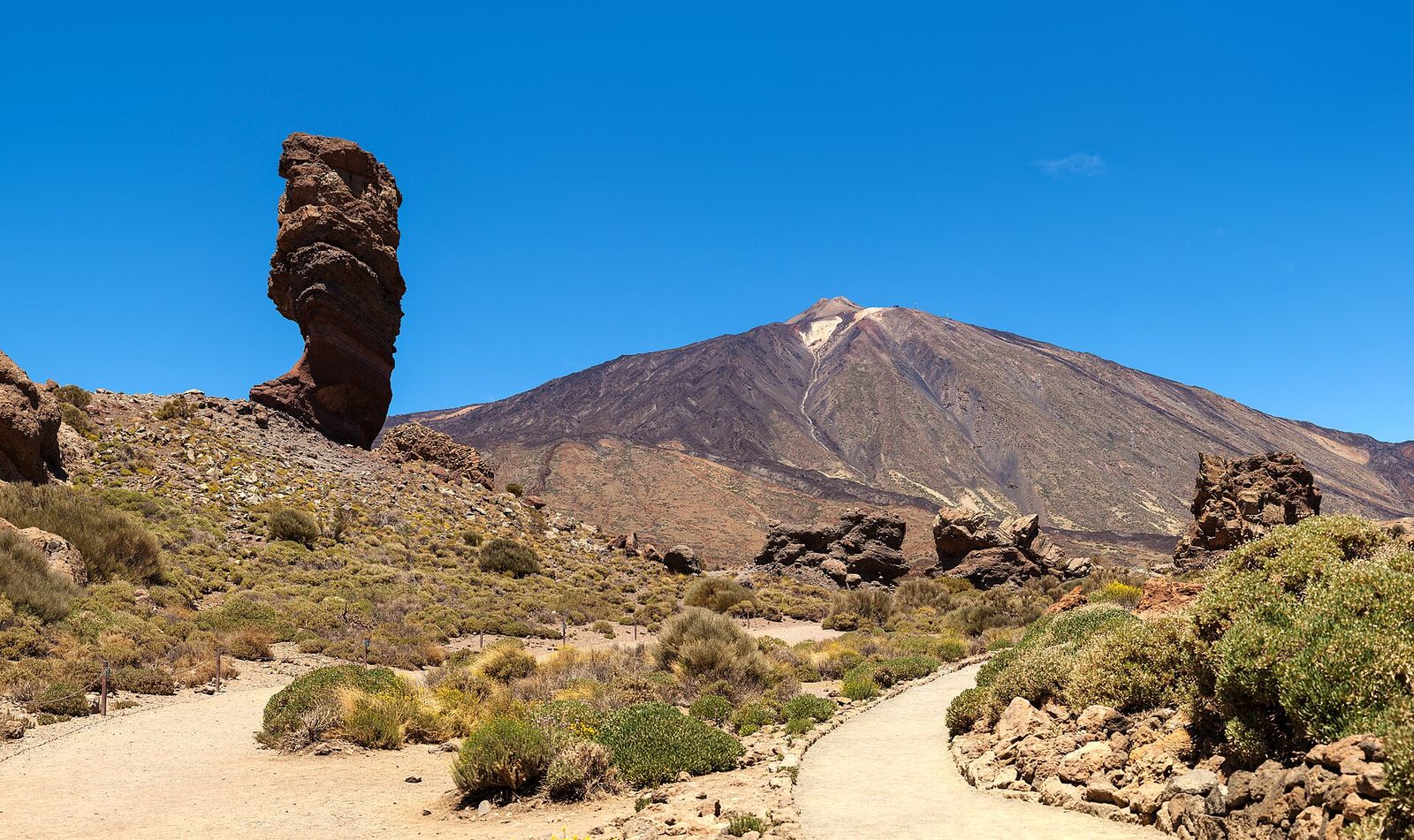
Teide is the highest mountain in Spain at 3,715 metres, and measured from the sea floor, about 7,500 metres, one of the tallest volcanoes on Earth.1 It is also the most visited national park in Spain: 5,113,021 visitors in 2025, five times more than in 1989.4 Most of them never reach the top. The cable car, which climbs from 2,356 to 3,555 metres in about eight minutes, leaves you at La Rambleta, 160 metres below the summit.1 The last short stretch of trail, called Telesforo Bravo after the Canarian geologist, are the most protected path in the park.
The reason is simple: a narrow, steep trail at almost 3,700 metres with loose rock, active fumaroles and a crater that cannot take thousands of people a day. So the park works with a quota.
How the permit works in 2026
Permits are booked only on the Cabildo's Tenerife ON website. Every Monday at 07:00 Canary time a new week opens, so there are always 56 days available.2 On the day you must carry the permit (printed or on your phone) and your ID or passport.2
The rules updated by the Cabildo on 6 October 2026 split the summit trail into time slots:3
- 06:00-07:30: 49 places, only for guests of the Altavista refuge.
- 07:30-09:00: a few places for individuals, bivouac, mountain federation members and accredited guides.
- 09:00-18:00: successive slots of 90 minutes, around 40 places for individuals and 10 for guides in each.
- 18:00-22:00: a last evening slot.
- 22:00-06:00: no permits at all.
Each request can include up to 9 people, one slot per day, and you cannot book again for the 7 days before and after your date.3 If you do not show up without a good reason, you can be barred from booking for three months.3
The fees (for the 09:00-18:00 slots) are new for 2026: free for residents of Tenerife and children under 14, 6 € for residents of the other Canary Islands and 15 € for everyone else.3 An early version of the park's management plan had talked of up to 25 € for non-residents.6 Refunds are given if you cancel at least three days before, if the trail is closed or if the cable car is not running.3
Three legal ways to the top
1. Cable car plus permit. The classic. Buy a cable car ticket and book a summit slot that starts after you arrive. The two are separate purchases on separate websites: a cable car ticket on its own does not let you on the summit trail.2
2. On foot from Montaña Blanca. The PNT 07 trail climbs from the TF-21 road (km 40.7) past Montaña Blanca and the Altavista refuge to La Rambleta. It has its own permit, with fees on weekends and holidays for non-residents, and your reserved time is the time you pass the control point, about 4.6 km in.3 It means about 1,200 metres of ascent at altitude; from La Rambleta you still need a summit slot.
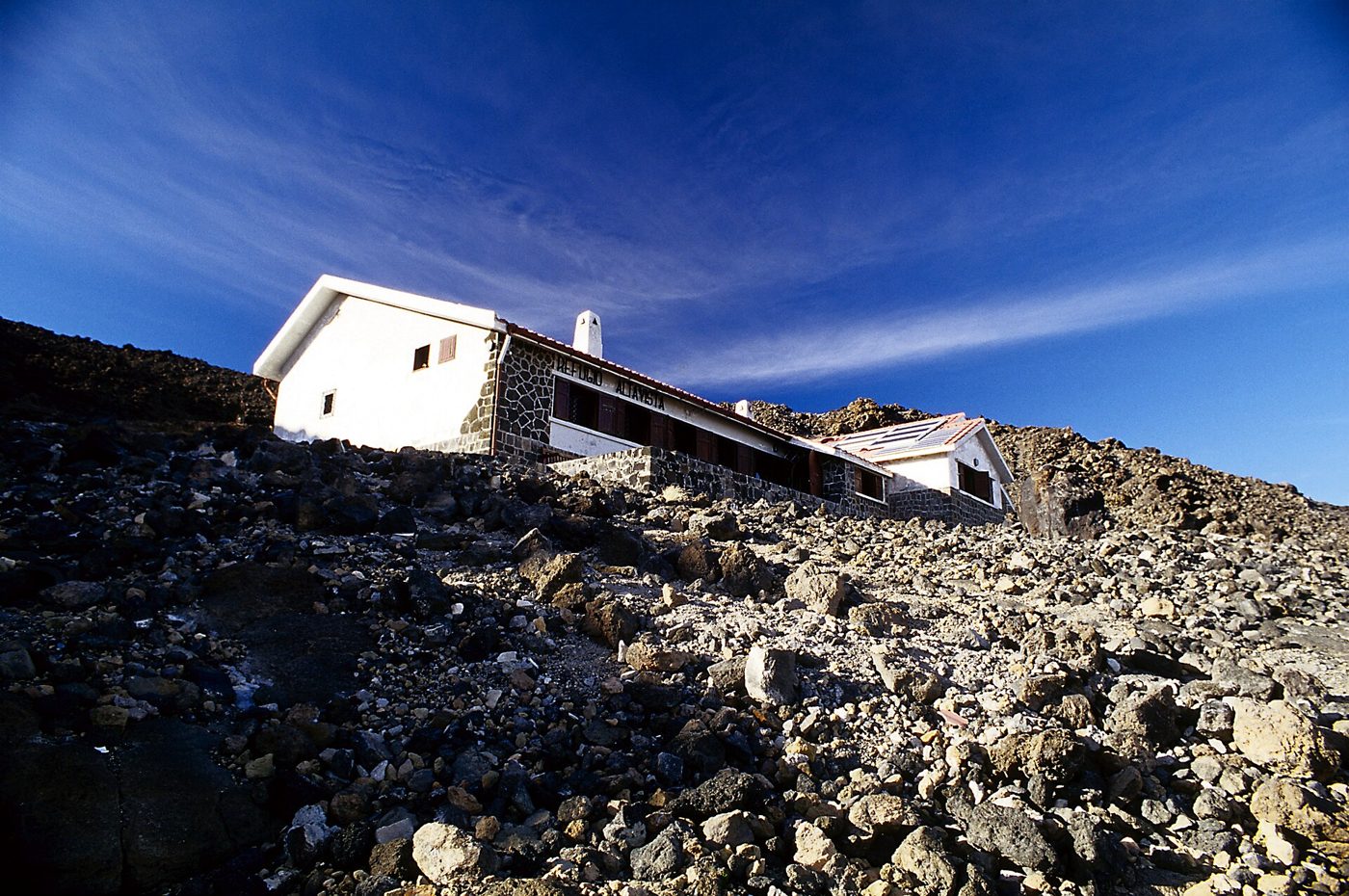
3. Altavista and sunrise. The refuge at 3,260 metres reopened in July 2026 after renovation. A night costs 71 €, or 29 € for Tenerife residents and 56.80 € for federated mountaineers.7 Its guests have their own summit slot from 06:00 to 07:30, which is how you see the famous triangle of Teide's shadow over the clouds at sunrise.3
Why the rules got strict
The turning point was a weekend in November 2024. With a storm pre-alert in force and the cable car closed, temperatures dropped to around -8 °C and the summit was covered in ice. Between Saturday and Monday 130 people had to be evacuated, three of them by helicopter with altitude sickness. Many had walked up at night to watch the sunrise and planned to ride the cable car down.5 The Cabildo banned walking up between 16:00 and 09:00, stopped selling descent-only cable car tickets, which hikers were buying at a rate of about 1,800 a month, and announced fines.5 The fire brigade put the cost of each rescue at around 1,800 € per person: 1,200 for the rescue and 600 for the fine.5
Today the mandatory kit for the summit trail is short but strictly checked: long trousers, a fleece or similar jacket even in summer, and closed walking shoes with a deep tread. Staff can turn you away even with a valid permit.3 On the longer trails the list adds a charged phone, a thermal blanket, water, a hat, gloves and a headlamp.3 When there is snow or ice, the Cabildo can close the trails and cancel bookings, or open them only to experienced mountaineers with crampons.3
Teide in numbers
3,715 m
official height of Teide, the highest point in Spain.1
5.1 million
visitors to the national park in 2025, the most visited in Spain.4
56 days
ahead: the booking window, which opens a new week every Monday at 07:00.2
15 €
summit fee for non-residents of the Canaries (6 € other islands, free for Tenerife).3
130
people evacuated from the summit area in one November 2024 weekend.5
600 €
fine for entering without a valid reservation.3
What you will find at the top
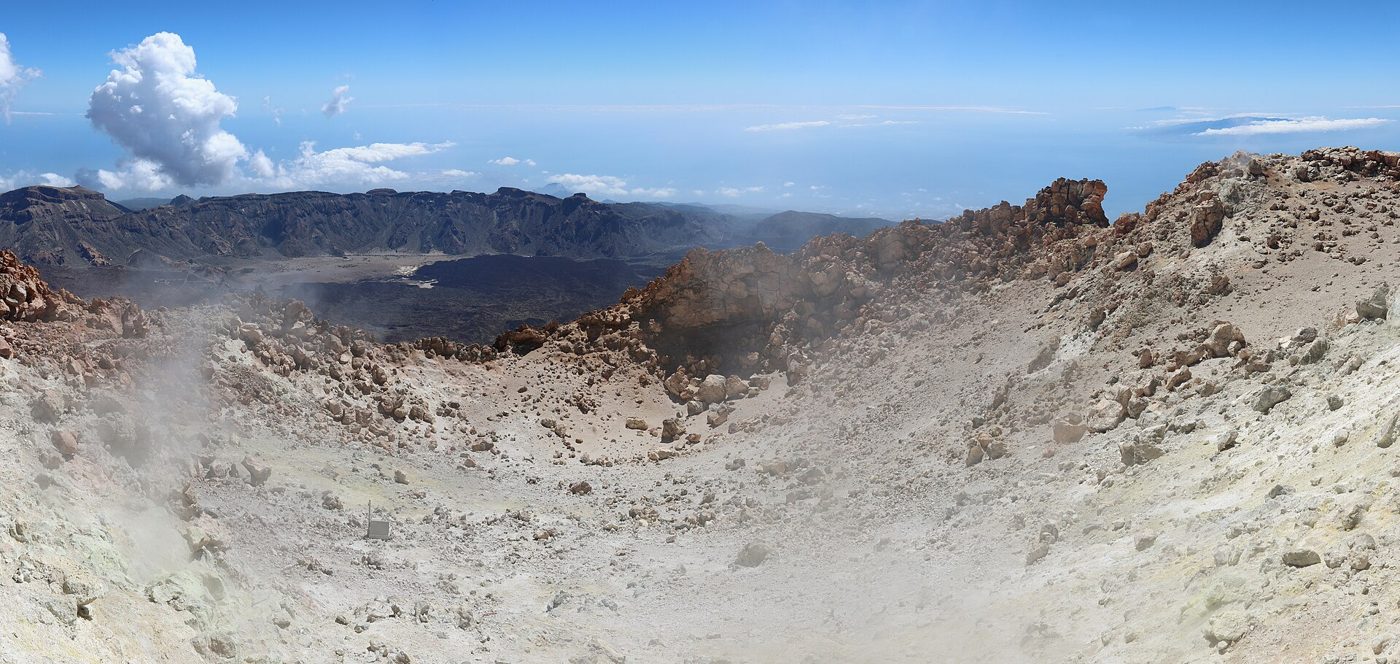
Teide is an active volcano, sleeping since its last eruptions on its flanks: Chahorra on Pico Viejo in 1798 and Chinyero in 1909.1 At the summit small fumaroles release sulphur dioxide and traces of hydrogen sulphide, and the ground is warm.1 It is forbidden to leave the trail, walk around or into the crater, or stay beyond your slot.3 The air has roughly a third less oxygen than at sea level, so headaches, nausea and dizziness are common: go slowly, drink water and turn back if symptoms get worse.
Common myths
Myth
The cable car ticket includes the summit.
Fact
It does not. You need a separate permit for the Telesforo Bravo trail.2
Myth
If you start walking at night, nobody checks.
Myth
Permits are impossible to get.
Myth
It is summer on the coast, so it is summer on top.
Fact
At 3,700 m it can freeze any month; in November 2024 it reached -8 °C.5
What to do
- Book the summit permit on Tenerife ON the Monday the date opens, then book the cable car for a time before your slot.
- Carry the permit and your ID or passport; residents need proof of residence for the free or reduced fee.
- Wear long trousers, a warm jacket and closed shoes with deep grip, even in August, or you can be refused entry.
- Check the Tenerife ON alerts and the cable car status the day before and in the morning: wind closes the cable car often.
- If you feel dizzy, sick or have a severe headache, go down. Altitude sickness only gets better by descending.
- In an emergency call 112.
Notes and sources
- 1.Wikipedia (en), "Teide" (height according to the IGN, cable car stations and capacity, eruptions of 1798 and 1909, summit fumaroles), consulted October 2026. en.wikipedia.org
- 2.Gobierno de Canarias, Parques Nacionales de Canarias, Parque Nacional del Teide, "Reservas" (booking via Tenerife ON, 56-day window, documents required, cable car ticket not valid for regulated trails). gobiernodecanarias.org
- 3.Jotaland Outdoor Club, "Nuevas normas para subir al Teide", updated October 2026, summarising Cabildo de Tenerife resolution R0000136361 of 6 October 2026 (slots, quotas, fees, equipment, closures, fines under Law 4/2017, art. 392.3.f). senderismograncanaria.com
- 4.Ariadna Martínez, "Garajonay bate récord y el Teide lidera España", Atlántico Hoy, 12 July 2026. atlanticohoy.com
- 5.Planeta Canario, "El Cabildo prohíbe subir el Teide a pie por la tarde y de noche, tras evacuar a 130 personas, a las que multará", 19 November 2024. planetacanario.com
- 6.Climática, "Subir al pico del Teide costará hasta 25 euros a los no residentes en Canarias", 2025 (initial approval of the park's management plan). climatica.coop
- 7.Diario de Avisos, "Es oficial: dormir en el refugio de Altavista costará 29 euros a los residentes", 16 July 2026. diariodeavisos.elespanol.com
Keep reading
Water
Tenerife drinks from inside the volcano
Sewage
What goes into the sea
Housing
Housing in numbers
Politics
Who governs the Canaries, and what comes next
Volcano
The volcano under watch
Traffic
TF-5: anatomy of a traffic jam

Shopping
Why a parcel from Madrid can cost more than one from China
Population
Who lives on Tenerife
Hotels
Who owns Tenerife's hotels
Economy
What Tenerife lives on
Weather
Tenerife's weather, floor by floor

Food and restaurants
Tenerife at the table