
Sewage
What goes into the sea
180 pipes and outfalls on Tenerife's coast, a European court ruling naming twelve of its towns and resorts, a beach closed for a year and a prosecutor asking questions. The sewage problem without the sugar-coating, with the numbers on both sides.
10 min read · 14 sources · Updated October 2026
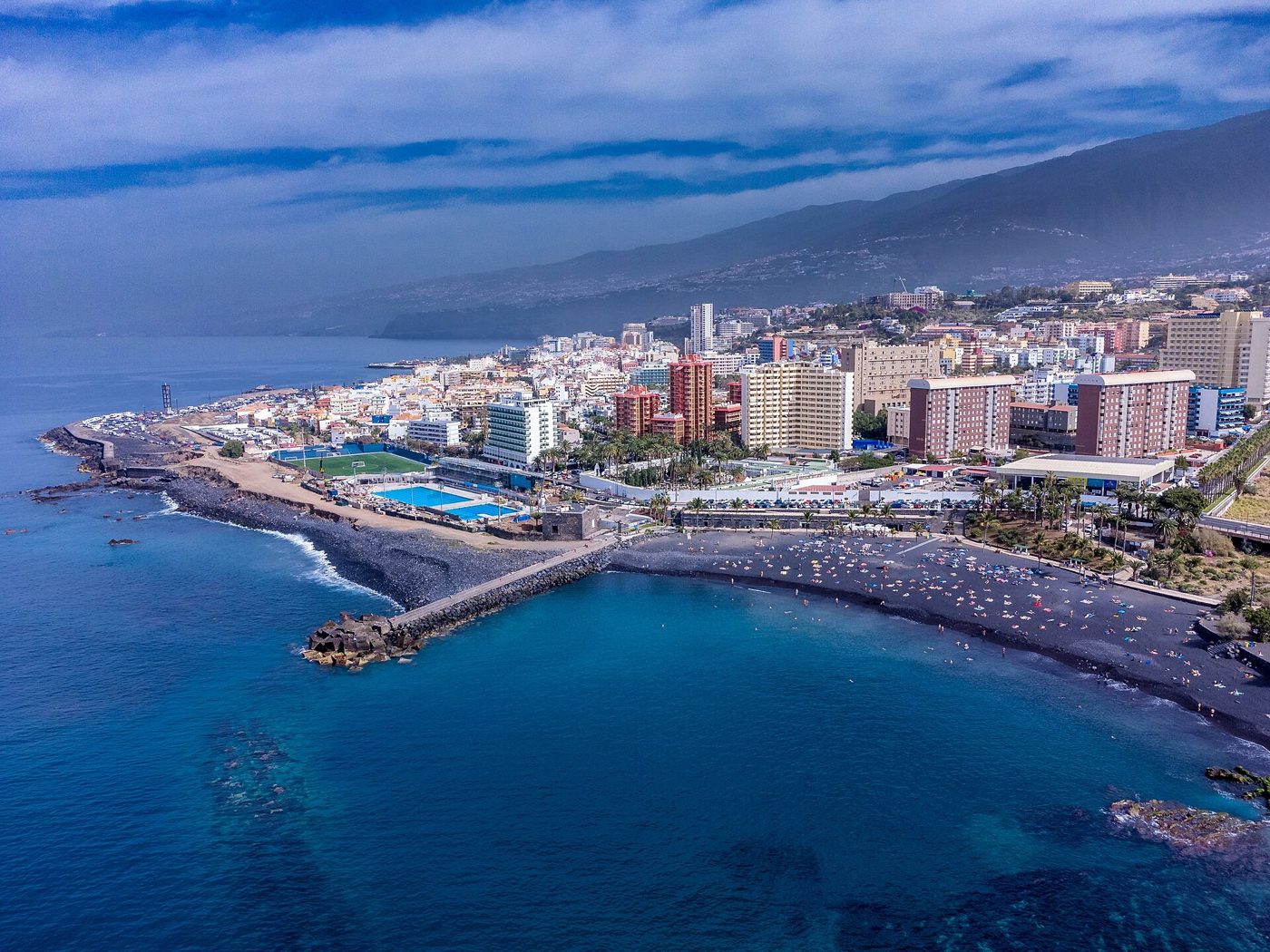
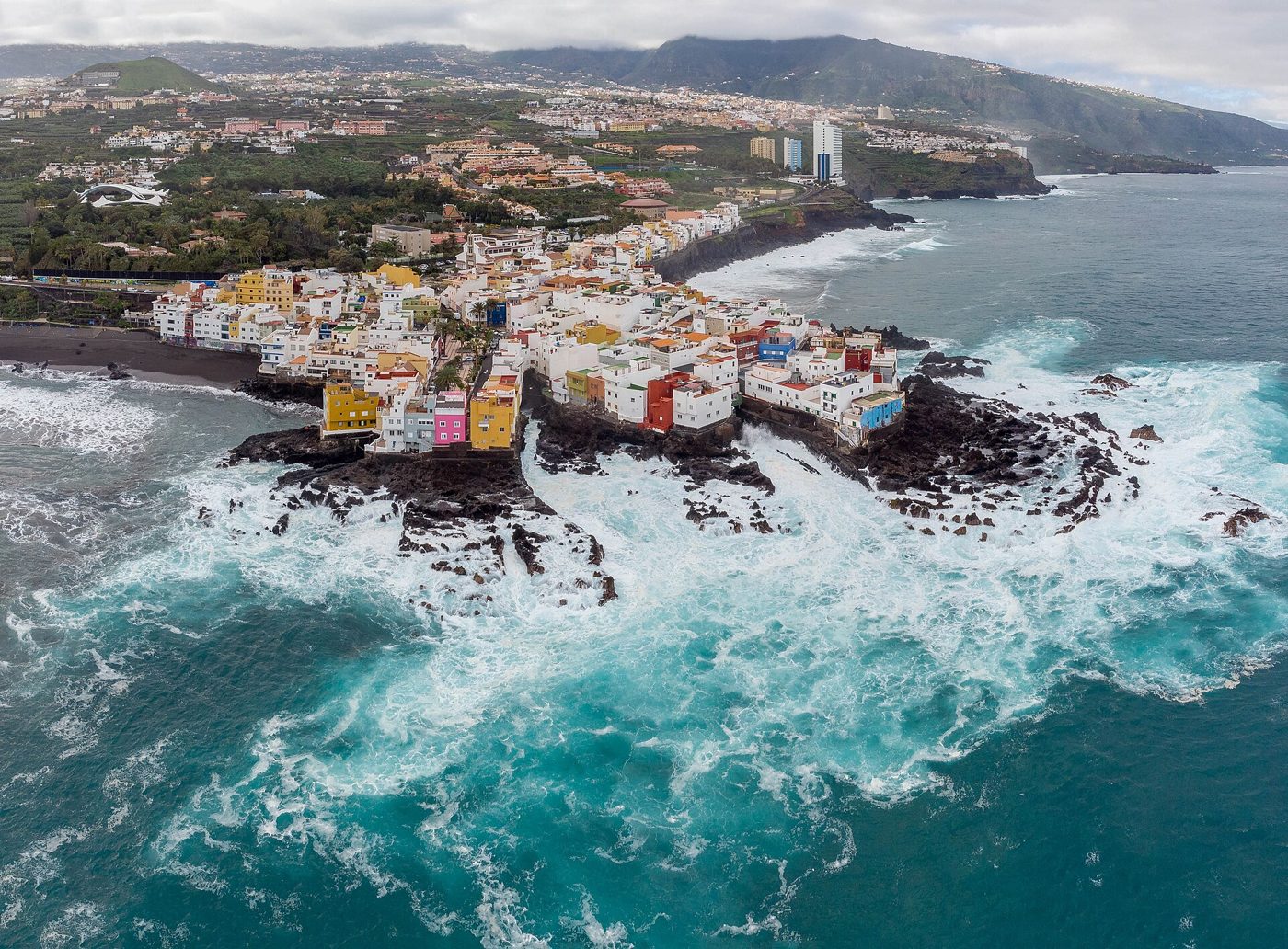
Playa Jardín · Clemenspool, CC0
In short
- Tenerife has more land-to-sea discharge points than any other Canary island: 180 of the 403 counted in the archipelago in 2025.1
- In December 2025 the EU Court of Justice ruled against Spain over wastewater, and most of the places named were on Tenerife: twelve towns and resorts.3
- Official tests rate almost every bathing zone as excellent, yet Playa Jardín was closed for a year and short closures happen about nine times a year.5,6
- The Cabildo says it went from treating 52% to 86% of the island's sewage in three years and aims for 97%. Campaigners say the fix is decades late.4
403 pipes to the sea
Every coastal island has to decide what to do with its sewage. In the Canaries, for decades, a large part of the answer was a pipe to the sea. In July 2025 the Canary Islands government updated its census of land-to-sea discharges: 403 points across the islands, down from 434 in 2021, of which 351 were active.1 Only 55% of the active ones were authorised or in the process of being authorised; 64% belonged to public bodies such as town halls and island councils.1 Tenerife alone has 180 points, the most of any island, ahead of Gran Canaria with 115.2
The census distinguishes carefully between "authorised", "in process" and "not authorised", and the headline number depends on how you count. A 2026 report by the Fundación Canarina and the Observatorio de la Sostenibilidad, presented at the University of La Laguna, concluded that 291 of the 403 points (72%) lacked a valid authorisation, with Tenerife the island with the most, 121.7 The government's own target is modest: by 2027, 85% of the unauthorised points should at least be "in process".1
Why so many? The government itself names the lack of treatment plants and of qualified staff to process the permits, and it puts the responsibility, and the bill, on town halls and Cabildos.1
Treated, half-treated or raw
A discharge point is not necessarily raw sewage. Many outfalls carry water that has gone through a treatment plant. But "treated" covers a lot of ground. Ricardo Haroun, director of the Ecoaqua institute at the University of Las Palmas de Gran Canaria, points out that most outfalls only receive secondary treatment, which still leaves plenty of nitrogen and phosphorus that damage marine life.8 Then there are the overflows of pumping stations, which send untreated sewage to the sea when pipes are full or pumps fail, and the homes that are simply not connected to the network.9
The Cabildo's figures show how far behind the island was. According to its president, Rosa Dávila, Tenerife treated 52% of its wastewater three years ago and 86% in September 2026, after raising treatment capacity from 92,700 to 152,700 m³ a day. The island expects to reach 97% once two large state-built plants, for the metropolitan area and for Arona-Este-San Miguel, are finished.4 Put the other way round: until very recently, almost half of the island's sewage was not properly treated.
Europe's verdict
Brussels has been warning Spain about urban wastewater since the 1990s directive on the subject. In 2018 the EU Court of Justice fined Spain 12 million euros plus a penalty for every six months of delay for not complying with an earlier ruling.10 The Canary Islands government says it paid 8.22 million euros of those fines between January 2019 and July 2023.10
On 18 December 2025 the court ruled against Spain again (case C-433/23), this time for failing to collect, treat and control wastewater properly in dozens of urban areas. Most of them were on Tenerife: Acorán, Adeje-Arona, Añaza, Candelaria-Casco, Candelaria-Punta Larga, Golf del Sur, Guía de Isora Litoral, La Esperanza-La Laguna Sur-Santa Cruz-Valles, Puerto de Santiago-Playa La Arena, San Isidro-Litoral, Sueño Azul and the Orotava valley.3 Spain argued that the islands relied on individual systems such as septic tanks; the court rejected that defence because those systems did not meet the directive's requirements.3 The ruling carried no fine by itself, but it is the step that comes before one.
Playa Jardín: anatomy of a closure
Playa Jardín, the black-sand beach designed by César Manrique in Puerto de la Cruz, became the symbol of the problem. The prosecutor's version of events, set out in a complaint filed in July 2025, goes like this:9
- 10 July 2020: an underwater inspection finds a leak in the Punta Brava outfall, which carries effluent from the Orotava valley treatment plant. It is not repaired until June 2023.
- 2018-2024: water quality worsens and E. coli levels rise "abruptly".
- 21 June 2024: public health officials advise against bathing. On 3 July 2024 the town hall closes the beach. Bathing stays off-limits until June 2025.
- After the closure: only provisional repairs; the prosecutor calls the infrastructure obsolete and says a section of about 240 metres must be replaced. Two nearby pumping-station overflows were working without authorisation and with no treatment.
The environmental prosecutor of Santa Cruz de Tenerife filed a complaint against six public officials, among them a former mayor, sitting town and island councillors and the manager of the Island Water Council, for a possible crime against natural resources and the environment.9 It is an investigation, not a conviction. In October 2026 it was still open, and the beach had just been closed for the third time that year, while the town hall disputed the results with tests from its own private laboratory.11
How often do beaches really close?
Here the official picture and the street's picture diverge. Public health officials monitor 50 bathing zones in 17 municipalities on Tenerife, at 62 sampling points. In 2025, 57 of those points were rated excellent, four good and one sufficient.5 Recommended closures by year: 13 in 2020, 12 in 2021, 6 in 2022, 5 in 2023, 12 in 2024, 8 in 2025, and 11 up to the end of September 2026, with Playa Jardín closed three times.5 Health officials say there is no upward trend.5
Critics point to how the numbers are produced. Points are sampled between 9 and 21 times a year, depending on the zone.5 A spill between two samples may never appear in the statistics. In July 2026 a sample at Leocadio Machado beach in El Médano found 800 E. coli colonies per 100 ml, well above the 500 used as the limit for "sufficient" quality; the beach was restricted for three days and the town hall said the cause was "unknown".6 At El Médano someone hung a banner reading "Bienvenidos a El Mierdano".6
You may also have read that 100 million litres of untreated or poorly treated sewage reach the Canarian sea every day. The figure went around the world when the travel guide Fodor's put the islands on its "No List", but we have not found an official dataset behind it, so we do not repeat it as fact.12 What the official numbers do show is enough: hundreds of unauthorised points and, until three years ago, half of Tenerife's sewage poorly treated.1,4
What goes into the sea, in numbers
180
land-to-sea discharge points on Tenerife, the most of any Canary island (2025 census).2
72%
of the 403 points in the Canaries lacked a valid authorisation, according to the SOS Costas Canarias report (2026).7
12
Tenerife towns and resorts named in the EU Court of Justice ruling of 18 December 2025.3
52% → 86%
share of Tenerife's wastewater treated, three years ago and in September 2026, according to the Cabildo.4
8.22 M€
paid by the Canary Islands in EU wastewater fines between 2019 and 2023.10
1 year
Playa Jardín stayed closed to bathing, July 2024 to June 2025.9
The protests
Discontent moved from social media to the street. On 23 March 2025 the Stop Vertidos al Mar platform marched in Puerto de la Cruz from Martiánez to the Punta Brava treatment plant, past the closed Playa Jardín. "We have a good climate, but we have no beach," said its vice-president, Candelaria Padilla.13 In May 2025 about a hundred people, mostly surfers, protested at Playa Honda in Arona, called by the environmental group ATAN and the collective Alianza Local, demanding transparent testing and preventive closures: "the sea is not a dump".14 Environmental groups have since given "black flags" to several Canarian beaches, Las Teresitas among them, and ATAN has gone as far as saying that bathing in the Canaries is a health risk.6
The authorities answer with investment. The Cabildo counts 364 million euros mobilised in sanitation and treatment, plus 147 million under a new agreement with the State company Acuaes, and the number of treatment plants on the island has grown from 8 to 12.4 A new western plant in Guía de Isora started work in February 2026 and a new plant for the Orotava valley is under way.4 Whether that is fast enough is precisely what the protests are about.
Common myths
Myth
If a beach is open, the water is clean.
Fact
Most samples are clean, but each point is tested only 9 to 21 times a year, so a short spill can go unrecorded.5
Myth
Treated sewage is harmless.
Fact
Secondary treatment removes much of the organic load but leaves nitrogen and phosphorus that harm the seabed.8
Myth
This is a tourist-season problem.
Fact
The pipes and overflows work all year; closures were recorded in every year from 2020 to 2026.5
What to do
- Before swimming, check the beach's status on the Ministry of Health's NAYADE website or the Canary Islands public health service.
- Avoid swimming near outfalls, ravine mouths and harbours for a day or two after heavy rain, when overflows are most likely.
- A red or "no bathing" flag for health reasons applies even if the sea looks perfect.
- If you see or smell a discharge, report it to the town hall and to SEPRONA (062), with a photo and the exact location.
- You can see every censused discharge point on the government's map (GRAFCAN viewer of the land-to-sea discharge census).
Notes and sources
- 1.RTVC, "Actualizan el censo de vertidos de Canarias para avanzar en su regulación y control al mar", 21 July 2025 (presentation by the regional minister for Ecological Transition, Mariano H. Zapata). rtvc.es
- 2.Natalia G. Vargas, "Vivir en una isla y no poder disfrutar del mar: la contaminación de las playas empuja a los canarios a las piscinas", Canarias Ahora, 18 July 2026 (census figures by island). eldiario.es
- 3.Canarias Ahora, "La Justicia europea condena a España por la falta de control sobre los vertidos de aguas residuales al mar en Canarias", 19 December 2025; Court of Justice of the EU, judgment of 18 December 2025, case C-433/23, Commission v Spain. eldiario.es
- 4.LD Canarias, "Tenerife dispara su capacidad para depurar aguas residuales y prevé alcanzar el 97% con las obras en marcha", 26 September 2026 (figures given by the Cabildo president at the island plenary). libertaddigital.com
- 5.Diario de Avisos, "Tenerife suma 11 cierres de zonas de baño en 2026 por contaminación", 5 October 2026 (data from the Servicio Canario de la Salud). diariodeavisos.elespanol.com
- 6.As note 2 (El Médano sample of July 2026, banner, black flags and ATAN's statement).
- 7.Adrián Galván, "El 72% de los vertidos al mar en Canarias no cuenta con autorización vigente", Diario de Avisos, 9 May 2026, on the report SOS Costas Canarias by the Fundación Canarina and the Observatorio de la Sostenibilidad. diariodeavisos.elespanol.com
- 8.COPE Canarias, "La grave amenaza que esconden las costas de Canarias: 291 puntos de vertido no están autorizados", 7 September 2026 (interview with Ricardo Haroun, Ecoaqua-ULPGC). cope.es
- 9.Canarias Ahora, "Falta de controles, cloro e impacto en la salud humana: la denuncia de la Fiscalía por los vertidos en una playa de Tenerife", 27 August 2025. eldiario.es
- 10.Atlántico Hoy, "Canarias pagó más de 8,2 millones de euros en cuatro años en multas de la UE por incumplir la depuración de aguas", 30 July 2026 (answer of the Canary Islands government to a parliamentary question). atlanticohoy.com
- 11.Gabriela Gulesserian, "La contaminación fecal obliga a cerrar playa Jardín por tercera vez este año", Diario de Avisos, 1 October 2026. diariodeavisos.elespanol.com
- 12.On the "100 million litres a day" figure: it is attributed to Fodor's "No List" and to environmental campaigners in British and German coverage, without a primary source. See e.g. britbrief.co.uk
- 13.RTVC, "Stop Vertidos al Mar se concentra en el Puerto de la Cruz", 23 March 2025. rtvc.es
- 14.Surf30, "Surfistas se manifiestan en contra de los vertidos al mar en Tenerife", 26 May 2025. surf30.net
Keep reading
Water
Tenerife drinks from inside the volcano
Housing
Housing in numbers
Politics
Who governs the Canaries, and what comes next
Teide
How to legally stand on top of Teide
Volcano
The volcano under watch
Traffic
TF-5: anatomy of a traffic jam

Shopping
Why a parcel from Madrid can cost more than one from China
Population
Who lives on Tenerife
Hotels
Who owns Tenerife's hotels
Economy
What Tenerife lives on
Weather
Tenerife's weather, floor by floor

Food and restaurants
Tenerife at the table