

Economy
What Tenerife lives on
A 23-billion-euro economy built on tourism, two tax systems, an IGIC that breaks records every year, 1.8 billion euros a year in state taxes paid in the province, pensions worth more than the Cabildo's budget twice over, EU money for bananas and the largest companies on the island, which mostly sell fuel. Where the money comes from, who pays and where it goes.
12 min read · 22 sources · Updated October 2026
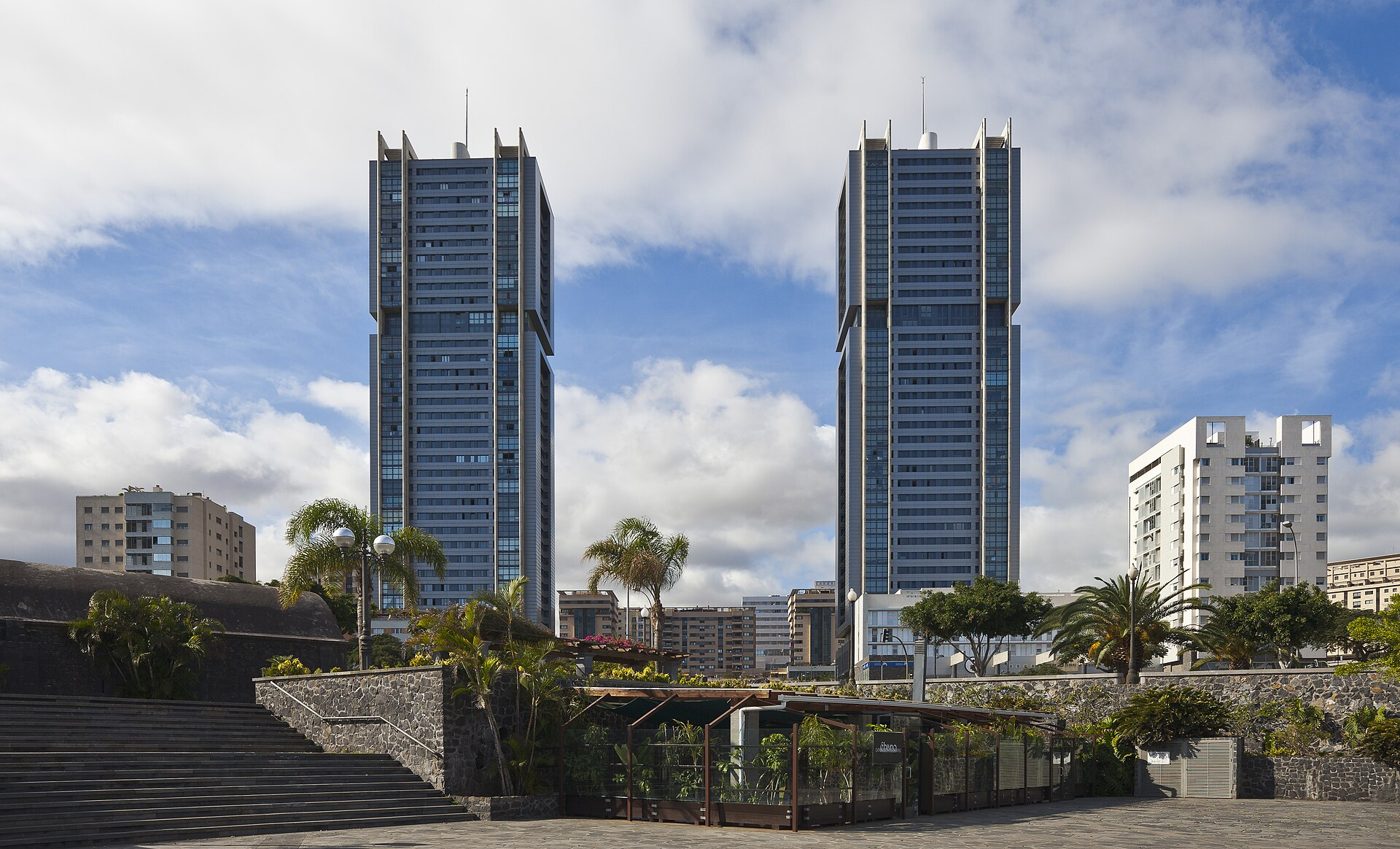
Torres de Santa Cruz · Diego Delso, CC BY-SA 3.0
In short
- Tenerife produced 23,329 million euros of GDP in 2023, 43% of the Canary Islands' economy; output per person in the Canaries is about 79% of the Spanish average.1,2
- Trade, transport and hospitality make up almost a third of the island's GDP, and tourism as a whole accounted for 37.7% of the Canarian economy in 2025.1,3
- The islands collect taxes twice: 3,881 million euros of Canarian taxes in 2025, led by IGIC, and 4,783 million of state taxes, 1,770 million of them in Santa Cruz de Tenerife province, mostly income tax.4,5
- Money also flows in: pensions, state subsidies such as the resident travel discount, and EU funds, including 141 million euros a year of aid for bananas.6,7,8
- Tenerife's residents owed 1,925 million euros of income tax on their 2024 returns; the average income per return ranges from 39,308 euros in El Rosario to 21,013 in Los Silos.21
The size of the economy
The Canary Islands statistics institute (ISTAC) puts Tenerife's gross domestic product at 23,329 million euros in 2023, 43.2% of the Canarian total of 53,990 million and 16% more than in 2019.1 It is the largest island economy in the archipelago, but not a rich one by Spanish standards: according to the National Statistics Institute, GDP per person in the Canaries in 2024 was about 25,900 euros, roughly 79% of the Spanish average of 32,633 euros.2
What Tenerife produces, by sector, in 2023:1
- Trade, transport and hospitality: 7,511 million euros, 32.2% of GDP. This is where most of the tourism business sits.
- Finance, real estate and professional services: 5,816 million, 24.9%, including the imputed value of homes and holiday rentals.
- Public administration, health, education and culture: 5,669 million, 24.3%.
- Industry: 1,453 million, 6.2%, much of it energy and water.
- Construction: 1,141 million, 4.9%.
- Agriculture, livestock and fishing: 358 million, 1.5%.
Tourism does not appear as a single line in national accounts because it spreads across hotels, restaurants, transport, shops and services. Measured that way, a study by Exceltur and the Canary Islands government puts tourism at 37.7% of the Canarian economy in 2025 (23,375 million euros) and 413,000 jobs.3 On Tenerife, visitors spent 9,134 million euros in 2025, and companies in the tourism sector employed 96,750 registered workers, almost a quarter of all jobs on the island.9
Two tax systems
Anyone living or doing business in the Canaries deals with two tax administrations.
The Canarian Tax Agency (ATC) collected 3,881 million euros in 2025, 6% more than in 2024.4 The heavyweight is the IGIC, the Canarian equivalent of VAT, with a general rate of 7% instead of 21%: 2,482 million euros, almost two thirds of the total. Then come the AIEM, a levy on certain imported goods designed to protect local production (301 million), the transfer tax on property sales (about 9.5% of the total), the tax on fuel (about 8.7%) and the tax on tobacco (about 3.5%).4 IGIC and AIEM form the so-called Canarian Financing Block, shared between the regional government and the island and town councils.10
The Spanish Tax Agency (AEAT) collected 4,783 million euros of state taxes in the Canaries in 2025, 61% more than in 2019. In Santa Cruz de Tenerife province (Tenerife, La Palma, La Gomera and El Hierro) the figure was 1,770 million euros:5
- Personal income tax (IRPF): 1,111 million, almost two thirds.
- Corporate tax: 321 million.
- VAT collected in the islands for operations subject to it: 220 million.
- Tax on non-residents' income: 64 million, which includes taxes on income from homes owned by people living abroad.
Part of that income tax returns to the Canary Islands government through the regional financing system, together with other transfers from the State.
Who pays income tax, town by town
The Spanish Tax Agency publishes every year how much taxpayers declare and owe in each municipality with more than 1,000 inhabitants. For 2024, residents of Tenerife's 31 municipalities filed 469,317 income tax returns, declared an average gross income of 29,152 euros per return and owed 1,925 million euros of income tax on them, about 14% of their gross income.21 That is the tax due on the returns, of which roughly half belongs to the Canary Islands government through the regional financing system, so it does not match the state collection figure above.
Two municipalities, Santa Cruz (578 million euros) and La Laguna (355 million), account for 48% of all the income tax owed on the island.21
Highest average gross income per return in 2024, with the average income tax owed per return:21
- El Rosario: 39,308 euros, 7,099 euros of tax
- Santa Cruz de Tenerife: 33,287 euros, 5,260 euros
- Candelaria: 32,760 euros, 4,947 euros
- Tegueste: 32,248 euros, 4,875 euros
- El Sauzal: 32,097 euros, 4,969 euros
Lowest:
- Los Silos: 21,013 euros, 2,039 euros of tax
- Buenavista del Norte: 21,579 euros, 2,069 euros
- El Tanque: 22,042 euros, 2,139 euros
- La Victoria de Acentejo: 22,637 euros, 2,308 euros
- Icod de los Vinos: 22,876 euros, 2,430 euros
The tourist south sits in the middle: Adeje 28,334 euros, Arona 26,234 and Granadilla 25,332. Per inhabitant the gap is wider: residents of Adeje owe 1,705 euros of income tax a year and those of Arona 1,495, against 2,728 in Santa Cruz and 3,752 in El Rosario.21 The tourist municipalities generate most of the island's turnover, but the highest declared household incomes are in the metropolitan area and its residential suburbs. These are averages per return: people with incomes low enough not to file are not included, and income is counted where the taxpayer lives, not where they work.
And by nationality?
No public statistic shows how much tax each nationality pays on Tenerife. The Tax Agency's income tax statistics distinguish at most between Spanish and foreign taxpayers, at national and regional level, never country by country or town by town. What is known: in October 2025 the Canaries had 137,313 foreign workers registered with Social Security, 80,349 from outside the EU and 56,964 from EU countries, who pay contributions and income tax like any other worker;22 and owners of property here who live abroad paid 64 million euros of non-resident income tax in the province in 2025.5 Any ranking of "who pays most by nationality" would have to be guessed from indirect data, so we do not publish one.
The special tax regime
The Canaries' Economic and Fiscal Regime (REF) is why taxes here look different, and why companies pay less than on the mainland:
- IGIC at 7% instead of 21% VAT, which lowers prices for everyone, residents and tourists alike.4
- The Reserve for Investments in the Canaries (RIC) lets companies leave up to 90% of their undistributed profits out of the corporate tax base, provided they reinvest them in the islands within three years. When the State changed the rules in 2025 to allow those funds to go into rental housing, it estimated that about 2,000 million euros of business profits were waiting to be invested.11
- The Canary Islands Special Zone (ZEC) offers a corporate tax rate of 4% to companies that set up and create jobs here.12
We have not found an official, up-to-date figure for the total cost of these tax breaks. What is certain is that the regional government has not lowered IGIC from 7% to 5%, as CC and the PP had promised: its draft budget for 2027, presented on 26 October 2026, keeps the general rate at 7%.13

The money that comes in
A large share of the island's income does not come from what it sells, but from transfers.
- Pensions. In Santa Cruz de Tenerife province the Social Security paid 180,970 pensions with an average of 1,232 euros a month in 2026.6 Over fourteen payments a year that is roughly 3,100 million euros, more than twice the Cabildo's budget. (Our own calculation from the official averages.)
- The resident travel discount. Residents of the islands pay only 25% of the fare on domestic flights; the State pays the rest to the airlines. The budget line for the discount, shared with the Balearic Islands, Ceuta and Melilla, was 560.81 million euros, plus extra credits, and in early 2025 airlines claimed 810 million euros of arrears, a figure the Ministry of Transport put at 300 million.7
- EU farm aid (POSEI). The EU pays the Canaries 268.4 million euros a year, plus 32 million of national top-up. Bananas alone receive 141.1 million euros a year, 53% of the total; the islands are asking for an increase of more than 60% in the next EU budget.8
- EU cohesion funds. For 2021-2027 the islands have 2,784.7 million euros from the European Regional Development Fund and the European Social Fund Plus, 1,544 million managed by the Canary Islands government and 1,242 million by the State.14
Where public money is spent on the island
The Canary Islands government has a budget of 12,491 million euros for 2026, most of it for health, education and social services, which it runs.15 The Cabildo de Tenerife manages 1,278 million euros in 2026: 417 million for social policies, 256 million for mobility (roads, buses and the tram), 202 million for the environment and the primary sector, 67 million for water, 45 million for tourism promotion and 15 million for housing. Its investment budget is 257 million.16 The 31 town councils add their own budgets, funded partly by their share of the Canarian Financing Block.10
The biggest companies
The largest companies registered in Santa Cruz de Tenerife province, by sales in 2023:17
- DISA Suministros y Trading (fuel group DISA): 2,065 million euros.
- Traveltino 2009 (travel agency): 498 million.
- DISA Red de Servicios Petrolíferos (service stations): 424 million.
- Prodalca España (fuel retail): 350 million.
- Fred. Olsen (ferries): 255 million. The company is controlled by the Norwegian Olsen family.18
Three of the top four sell fuel, a reminder of how much the island depends on imported energy. The biggest tourism businesses often do not appear in this ranking, because the large hotel chains are registered elsewhere: RIU alone had gross revenue of more than 4,000 million euros in 2024 across all its hotels (see our article on who owns Tenerife's hotels).19 Among locally owned groups, Fedola, the owner of GF Hoteles, had consolidated revenue of 142 million euros.20
What Tenerife lives on, in numbers
23,329 M€
Tenerife's GDP in 2023, 43% of the Canarian economy.1
79%
Canarian GDP per person compared with the Spanish average (2024).2
2,482 M€
IGIC collected in the Canaries in 2025, two thirds of all Canarian taxes.4
1,770 M€
state taxes collected in Santa Cruz de Tenerife province in 2025.5
~3,100 M€
a year in pensions paid in the province, by our calculation.6
141.1 M€
a year of EU aid for Canarian bananas.8
39,308 €
average gross income per tax return in El Rosario, the highest on the island; Los Silos has 21,013 €.21
Common myths
Myth
Tourists pay no taxes here.
Fact
Every tourist pays IGIC on what they buy and consume; IGIC collection grows with tourism and reached 2,482 million euros in 2025.4
Myth
The Canaries live off subsidies from Madrid and Brussels.
Myth
Low tax rates mean the islands collect little.
Myth
The biggest companies on the island are hotels.
Myth
The tourist towns are the richest.
Fact
Per tax return, the highest declared incomes are in El Rosario, Santa Cruz, Candelaria and Tegueste; Adeje and Arona are mid-table.21
What to do
- If you live here, use the Canarian deductions in your income tax return (rent, studies, birth, disability and others) and keep the receipts.
- Register as a resident (padrón and resident certificate) to get the 75% discount on domestic flights and ferries.
- Ask for invoices without Spanish VAT when you buy from the mainland, and check IGIC is correctly charged (see our article on parcels and IGIC).
- To see how your money is spent, look up your town hall's and the Cabildo's budget on their transparency portals.
- If you run a business, ask an adviser about the RIC and ZEC before you decide where and how to invest.
Notes and sources
- 1.ISTAC, "Producto Interior Bruto (PIB). Por ramas de actividad (CNAE-09), islas de Canarias y años", dataset E30014B_000005 (2024 statistical revision), consulted October 2026. istac
- 2.INE, Contabilidad Regional de España, 2024 estimates (Spanish average 32,633 euros per inhabitant); Canarian figure as reported by CCOO Canarias from INE data. ine.es
- 3.Exceltur and Gobierno de Canarias, Estudio IMPACTUR Canarias 2024 y avance 2025, May 2026. exceltur.org
- 4.Canarias7, "Diciembre rompe récords recaudatorios y lleva los ingresos tributarios a los 3.881 millones en 2025", 9 May 2026 (Agencia Tributaria Canaria data). canarias7.es
- 5.ISTAC, "Recaudación Tributaria del Estado. Comunidad autónoma y provincias de Canarias por periodos", dataset E32001A_000002 (AEAT net collection), 2019 and 2025, consulted October 2026. datos.canarias.es
- 6.Bankinter, "Pensión media en España por comunidades y provincias", 2026 (Social Security data: 180,970 pensions, average 1,232.06 euros, Santa Cruz de Tenerife). bankinter.com
- 7.Atlántico Hoy, "¿Cómo funciona el descuento de residente y por qué el Estado debe 810 millones a las aerolíneas?", 2025. atlanticohoy.com
- 8.Canarias Ahora, "Canarias aspira a engordar el 62% los fondos del Posei, pero aún no tiene agarradas ninguna de sus peticiones", 22 October 2026. eldiario.es
- 9.Turismo de Tenerife, Balance de situación turística de Tenerife 2025. webtenerife.com
- 10.Universidad de La Laguna, "La distribución de los recursos del REF entre las Haciendas canarias" (teaching material on the Canarian Financing Block). riull.ull.es
- 11.Ley 6/2025, de 28 de julio, de modificación de la Ley 19/1994 del Régimen Económico y Fiscal de Canarias (RIC investment in rental housing), preamble, BOE-A-2025-15651. boe.es
- 12.José Rosado, "Canarias se moviliza contra el turismo, que supone el 35,5% de su PIB y el 39,7% del empleo", El Debate, 20 May 2025 (Canarian tax regime: ZEC rate). eldebate.com
- 13.LD Canarias, "El presupuesto canario sube un 5,7% hasta 13.209 millones y vuelve a congelar la bajada del IGIC", 26 October 2026. libertaddigital.com
- 14.Gobierno de Canarias, "Canarias recibirá 2.786 millones de euros de ayudas con cargo al FEDER y el FSE para el periodo 2021-2027". gobiernodecanarias.org
- 15.Canarias Ahora, "El presupuesto de Canarias aumentará un 7% en 2026, hasta los 12.491 millones de euros". eldiario.es
- 16.Cabildo de Tenerife, "El Cabildo presenta un presupuesto que crece, refuerza el gasto social y mantiene a Tenerife al frente de la economía canaria", 30 October 2025. tenerife.es
- 17.Atlántico Hoy, "Las empresas más grandes de Santa Cruz de Tenerife: cuáles son y a qué sector pertenecen", 24 February 2026 (El Economista ranking, 2023 sales). atlanticohoy.com
- 18.Wikipedia (en), "Fred. Olsen Express", consulted October 2026. en.wikipedia.org
- 19.Forbes Travel España, "Los 100 españoles más ricos: las fortunas del turismo", 5 November 2025. forbes.es
- 20.Atlántico Hoy, "Fedola, así es el imperio femenino de Tenerife que alberga 280 millones en activos y 15 empresas", 10 November 2025. atlanticohoy.com
- 21.Agencia Tributaria, Estadística de los declarantes del IRPF por municipios, 2024, "Datos municipales por ámbito territorial" (returns, gross and disposable income, tax due per municipality), consulted October 2026. Per-inhabitant and per-return tax figures are our own division of the published totals. agenciatributaria.gob.es
- 22.RTVC, "Los afiliados extranjeros en Canarias superan los 137.000", November 2025 (Ministry of Inclusion, Social Security and Migration data, October 2025). rtvc.es
Keep reading
Water
Tenerife drinks from inside the volcano
Sewage
What goes into the sea
Housing
Housing in numbers
Politics
Who governs the Canaries, and what comes next

Teide
How to legally stand on top of Teide

Volcano
The volcano under watch
Traffic
TF-5: anatomy of a traffic jam

Shopping
Why a parcel from Madrid can cost more than one from China
Population
Who lives on Tenerife
Hotels
Who owns Tenerife's hotels

Weather
Tenerife's weather, floor by floor

Food and restaurants
Tenerife at the table