
Housing
Housing in numbers
The lowest wages in Spain, prices rising faster than almost anywhere, one in three homes sold to foreign buyers, tens of thousands of holiday lets, almost no public housing and a street movement that keeps growing. Tenerife's housing crisis, figure by figure.
9 min read · 17 sources · Updated October 2026
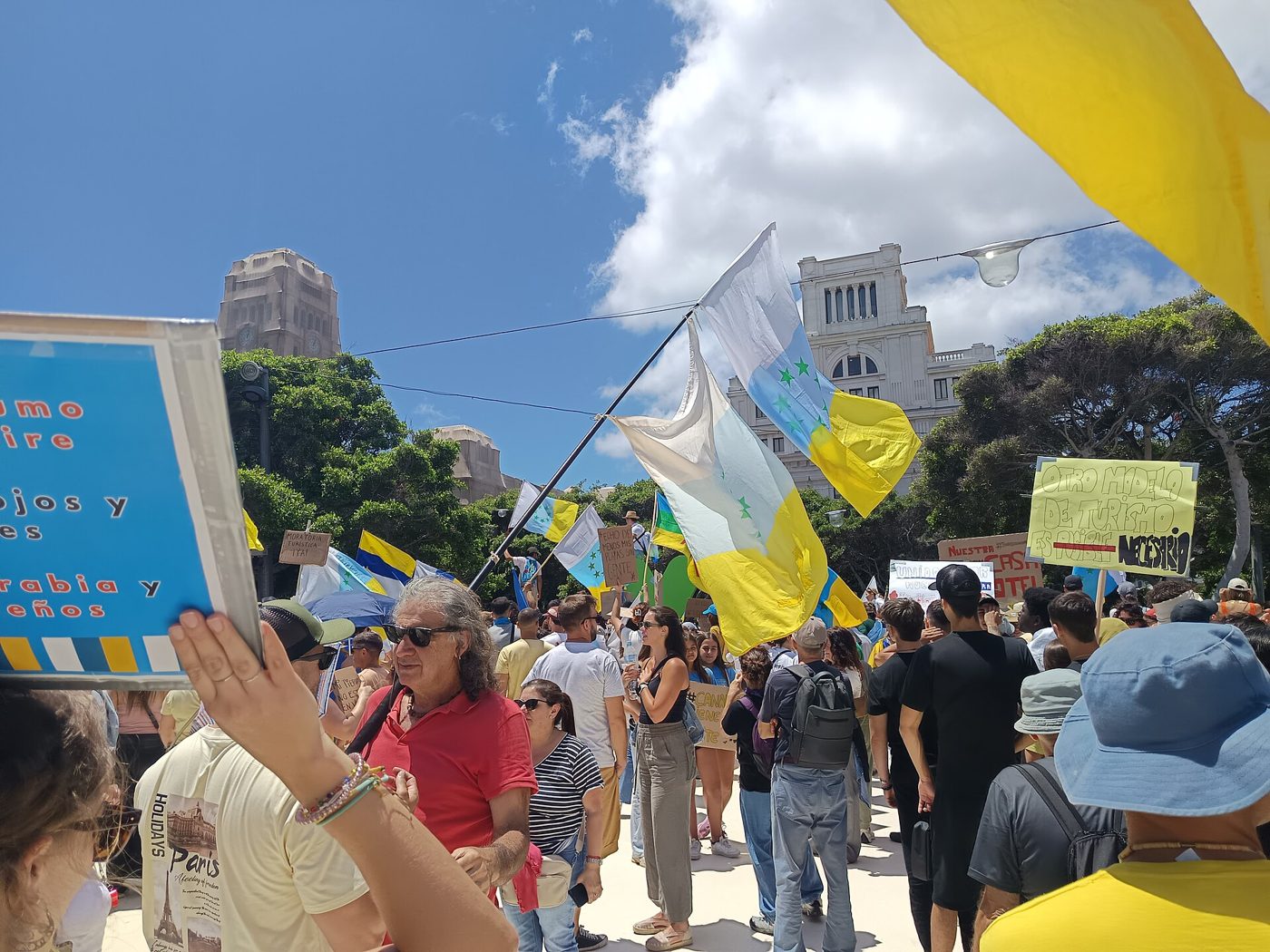
18-M demonstration, Santa Cruz de Tenerife · Soyneutral, CC BY-SA 4.0
In short
- In the second quarter of 2026 the Canary Islands had the lowest average wage of Spain's 17 regions: 2,016 € a month, about 500 € below the national average.1
- At the same time, appraised home values in the islands rose 14.2% in a year and asking rents in Santa Cruz de Tenerife province reached 15.3 €/m².2,3
- Over thirty years the islands built only 31,728 protected homes, with three years of absolute zero; in 2026, up to August, not a single public home was allocated.5,9
- Holiday lets, foreign buyers and empty homes all compete for the same stock. Since 2024, tens of thousands have marched under the slogan "Canarias tiene un límite".6,4,13
The arithmetic that does not work
Start with income. According to the National Statistics Institute's quarterly labour cost survey, the average monthly wage cost per worker in the Canaries was 2,016 € in the second quarter of 2026, the lowest of Spain's 17 autonomous communities, against a national average of 2,513 € and 3,060 € in Madrid.1 That is gross pay, before the worker's tax and social security, and it includes part-time jobs. It is also paid in a region that had a record 18.4 million tourists in 2025.1
Now look at prices. The Canary Islands statistics institute (ISTAC) put the average appraised value of free-market housing at 2,279 €/m² in the second quarter of 2026, 14.2% more than a year earlier.2 Asking prices on the property portal Idealista are higher still: in September 2026 homes for sale in Santa Cruz de Tenerife province were advertised at an average of 3,514 €/m², and in the city of Santa Cruz prices had risen 12.2% in a year.3 Rent was advertised at 15.3 €/m² a month in the province, 4.5% more than a year earlier.3
Put the two together. A modest 70 m² flat at the provincial average rent costs about 1,071 € a month. That is more than half of the average gross wage, while the usual rule of thumb says housing should not take more than 30%. (This is our own calculation from the figures above; real cases vary a lot by town and contract.)
Where did the homes go?
Very few were built for those who need them. Between 1991 and 2022 the Canaries built a total of 31,728 protected homes (VPO), and in 2018, 2020 and 2021 the figure was zero, according to a 2024 report by the CCOO union based on ministry data.5 Between the 2011 and 2021 censuses the housing stock grew by 47,520 homes; only 2,172 of them, about 4.6%, were protected, against 13.9% in Spain as a whole.5 Overall construction is slow too: around 3,000 new homes a year, and 2,782 in 2022.6
Many became holiday lets. The Canary Islands' holiday-rental law itself records that officially registered holiday homes rose by 25.7% in a single year, from 38,603 in November 2022 to 48,541 in November 2023. By July 2024 the register held 60,146 establishments with 247,551 beds across the islands, more than 37% of all tourist beds. Tenerife alone had 25,769 registered holiday homes with 104,427 beds, and in Adeje they made up 13.35% of all homes.6 The law's own preamble calculates that, at the current pace of construction, replacing the homes lost to tourist use would take about twenty years.6 The trend is now turning: the number actually listed on platforms fell 15% in a year, to 39,678 in July 2026, about 41% of them on Tenerife.7
Some are empty. The 2021 census counted 211,331 empty homes in the Canaries and another 83,722 used only occasionally.5 The figure is disputed: the Canary Islands housing observatory warns that the method is indirect and provisional, and many of those homes are in poor condition, in the wrong place or tied up in inheritance disputes.8
And demand keeps growing. Foreign buyers accounted for 32.25% of home purchases in Santa Cruz de Tenerife province in the second quarter of 2026, according to the land registrars, twice the Spanish average of 15.98%.4 Notaries see the share falling in 2026, and the figures swing a lot from quarter to quarter.4
Who falls through
In May 2026 Cáritas and the Cabildo of Tenerife published a count of people in extreme residential exclusion: 2,853 on the island. Almost half (47.7%) spend most of their time outdoors or in public spaces, and a quarter (25.5%) live in shacks, garages, tents, caravans, cars or unfinished buildings. Santa Cruz (about 998 people) and La Laguna (357) account for almost half of the cases, but Arona, Adeje, Granadilla and Puerto de la Cruz are also singled out.10 Workers living in motorhomes in the south, because they cannot pay rent near their jobs, have become a recurring story in the local press.11
Evictions follow the same pattern. In 2023 the courts carried out 1,398 evictions of tenants in the Canaries, and the islands have more evictions per 100,000 inhabitants than the Spanish average, which the CCOO report links to low wages, high prices and the islands' heavier reliance on renting.5
The safety net is thin. More than 34,000 people are on the waiting list for protected housing, some since 2010. In a written answer to Parliament, the Canary Islands government confirmed that it had not allocated a single protected home in 2026, and its only tender for Tenerife, 134 flats in Adeje, Guía de Isora and Arona worth 23.8 million euros, received no bids in February.9 The government blames construction costs and a shortage of skilled workers; the opposition calls its policy "headlines".9 Its housing company, Visocan, has meanwhile bought four existing buildings with 170 homes in La Orotava and Icod de los Vinos for 22.5 million euros.12
Housing in numbers
2,016 €
average monthly wage cost per worker in the Canaries, the lowest in Spain (Q2 2026).1
+14.2%
rise in appraised home values in the Canaries in one year (Q2 2026).2
32.25%
of home purchases in Santa Cruz de Tenerife province made by foreigners (Q2 2026).4
25,769
registered holiday homes on Tenerife, with 104,427 beds (July 2024).6
2,853
people in extreme residential exclusion on Tenerife (May 2026).10
0
protected homes allocated by the Canary Islands government in 2026, up to August.9
The holiday-let law
The regional answer so far is Law 6/2025 on the sustainable tourist use of homes, in force since 13 December 2025. It requires town plans to reserve at least 90% of residential floor space for permanent homes (80% on La Palma, La Gomera and El Hierro), caps holiday-let beds at 10% of the population of each settlement, only allows homes at least ten years old to become holiday lets, and automatically suspends new ones in areas declared as stressed housing markets. Existing holiday lets keep their licence for a transitional period, generally five years.6
Its effect will take years to measure. Tenant groups already say it is not enough while rents are not capped and stressed-market zones are not declared.15
The street
The protests began with the environment and ended up with housing at the centre. On 20 April 2024, under the slogan Canarias tiene un límite ("The Canaries have a limit"), the Government Delegation counted 30,000 people in Santa Cruz de Tenerife and 14,000 in Las Palmas; organisers spoke of 80,000 in Santa Cruz alone.13 On 18 May 2025 the official count was 23,190 across the islands, 15,000 of them on Tenerife; organisers said 90,000 marched in Santa Cruz. Among the demands: a real moratorium on hotels and holiday lets, a housing law and a tourist tax.14
In 2026 tenants took the lead. On 27 June the Tenerife Tenants' Union (Sindicato de Inquilinas de Tenerife) marched through La Laguna with about fifty organisations behind it, demanding an emergency housing plan with thirteen measures, stressed-market zones with real rent caps, taxes on large owners of empty homes and an end to campaigns that attract digital nomads.15 At the end of September, after the eviction of an 87-year-old woman in Madrid sparked camps across Spain, protesters camped for a week in Santa Cruz's Plaza de España, and on 3 October between 2,000 and 10,000 people marched in the city, depending on the source.16
Common myths
Myth
The crisis is caused by foreigners buying homes.
Myth
There are no homes, so we just need to build.
Myth
Holiday lets are a few flats here and there.
Fact
Tenerife had 25,769 registered holiday homes in 2024, more than 13% of all homes in Adeje.6
What to do
- Before renting, check that the landlord is the owner, see the flat in person and never send a deposit to someone you have not met.
- Under Spain's tenancy law (LAU), a contract for your main home lasts at least five years with a private landlord and seven with a company, even if the paper says one.17
- Ask for a written contract and receipts for every payment, and make sure you can register at the address (empadronamiento).
- If you are on a low income, register as an applicant for protected housing in the Canary Islands register (Decree 23/2026); without it you cannot be allocated a public home.
- If you face eviction, contact your town hall's social services and a tenants' union before the date of the hearing, not after.
Notes and sources
- 1.Román Delgado, "Canarias toca fondo en la redistribución de la riqueza con el salario: paga los peores sueldos de España", Canarias Ahora, 17 September 2026 (INE, Encuesta Trimestral de Coste Laboral, Q2 2026). eldiario.es
- 2.Helena Victoria Falcón Santana, "La compra de viviendas en Canarias por extranjeros se dispara al 30%...", Canarias7, 5 October 2026 (ISTAC appraised values, Q2 2026). canarias7.es
- 3.Idealista, price reports for sale and rent, Santa Cruz de Tenerife province, September 2026 (Idealista changed its methodology in July 2026). idealista.com
- 4.As note 2 (Colegio de Registradores, Q2 2026), and Consejo General del Notariado, first half of 2026, via que.es
- 5.CCOO Canarias, Informe sobre la vivienda en Canarias 2024 (data from the Ministry of Transport, INE 2021 census and CGPJ). canarias.ccoo.es
- 6.Ley 6/2025, de 10 de diciembre, de Ordenación Sostenible del Uso Turístico de Viviendas (Canarias), preamble and articles 4-5, BOE-A-2025-26358. boe.es
- 7.RTVC, "En Canarias hay un 15% de viviendas vacacionales menos que hace un año", 19 August 2026 (ISTAC experimental statistics, July 2026). rtvc.es
- 8.Atlántico Hoy, "Canarias duda del INE y trabaja para saber la cifra real de viviendas vacías". atlanticohoy.com
- 9.Moncloa.com, "Vivienda pública en Canarias: el Gobierno encadena un año sin una sola adjudicación", 3 August 2026 (written parliamentary answer of the Canary Islands government). moncloa.com
- 10.Cáritas Diocesana de Tenerife and Cabildo de Tenerife, report on extreme residential exclusion, May 2026, as reported by El Día / Tenerife Weekly, 12 May 2026. tenerifeweekly.com
- 11.Diario de Avisos, "Los alquileres y la falta de viviendas empujan a los trabajadores del sur de Tenerife a vivir en autocaravanas", May 2026. diariodeavisos.elespanol.com
- 12.Moncloa.com, "La vivienda protegida en Canarias crece: Visocan compra cuatro inmuebles en Tenerife por 22,5 millones", 6 August 2026. moncloa.com
- 13.RTVC, "Canarias salió a la calle en las manifestaciones del 20A", 21 April 2024. rtvc.es
- 14.Diario de Avisos, "Más de 23.000 personas asisten a las manifestaciones de 'Canarias tiene un límite', según Delegación del Gobierno", 18 May 2025. diariodeavisos.elespanol.com
- 15.Diario de Avisos, "Multitudinaria manifestación en Tenerife por la crisis de la vivienda", 28 June 2026. diariodeavisos.elespanol.com
- 16.Wikipedia (es), "Acampadas por el derecho a la vivienda en España de 2026", consulted October 2026, with the press reports it cites. es.wikipedia.org
- 17.Ley 29/1994, de 24 de noviembre, de Arrendamientos Urbanos, article 9 (as amended in 2019), consolidated text. boe.es
Keep reading
Water
Tenerife drinks from inside the volcano
Sewage
What goes into the sea
Politics
Who governs the Canaries, and what comes next
Teide
How to legally stand on top of Teide
Volcano
The volcano under watch
Traffic
TF-5: anatomy of a traffic jam

Shopping
Why a parcel from Madrid can cost more than one from China
Population
Who lives on Tenerife
Hotels
Who owns Tenerife's hotels
Economy
What Tenerife lives on
Weather
Tenerife's weather, floor by floor

Food and restaurants
Tenerife at the table