
Callao Salvaje · Towns of Tenerife
Callao Salvaje: a resort by decree
A wild pebble shore below the banana terraces of Adeje, declared a "Centre of National Tourist Interest" by Franco's government in 1969 at the request of the architect of Ten Bel. How a seventy-hectare plan became a town on the cliffs of Costa Adeje.
5 min read · 8 sources · Updated October 2026
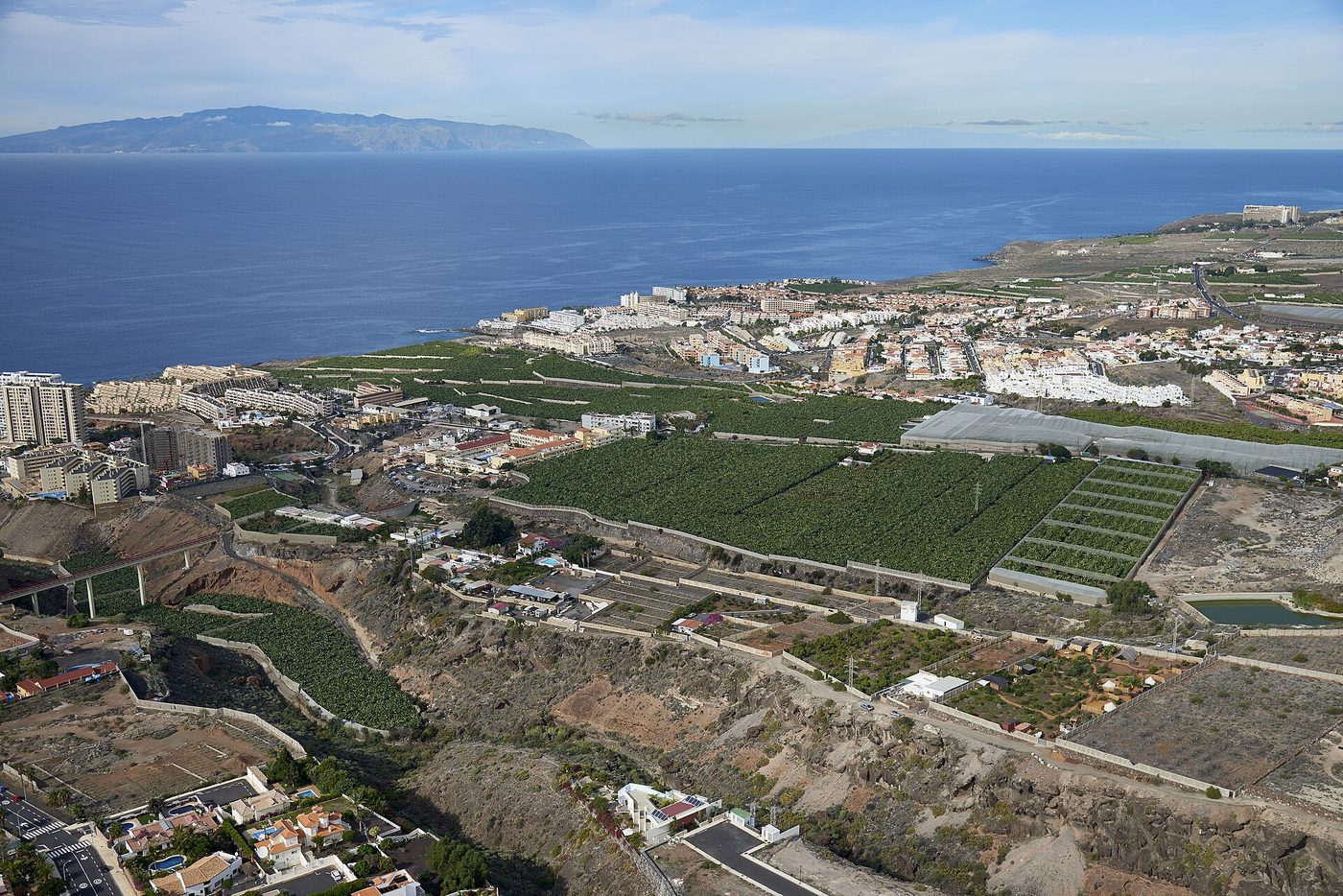
Callao Salvaje · Wouter Hagens, CC BY-SA 4.0
Callao Salvaje's name is a description. In the Spanish of the Canaries a callao is a rounded beach pebble, the grey stones that cover many of the island's shores, and salvaje means wild.8 Until the late 1960s that was all there was here: a rough coast of pebbles and lava below the dry slopes of western Adeje, with La Gomera floating on the horizon. What turned it into a resort was not a village or a harbour but a piece of paper signed in Madrid.
The shore before the resort
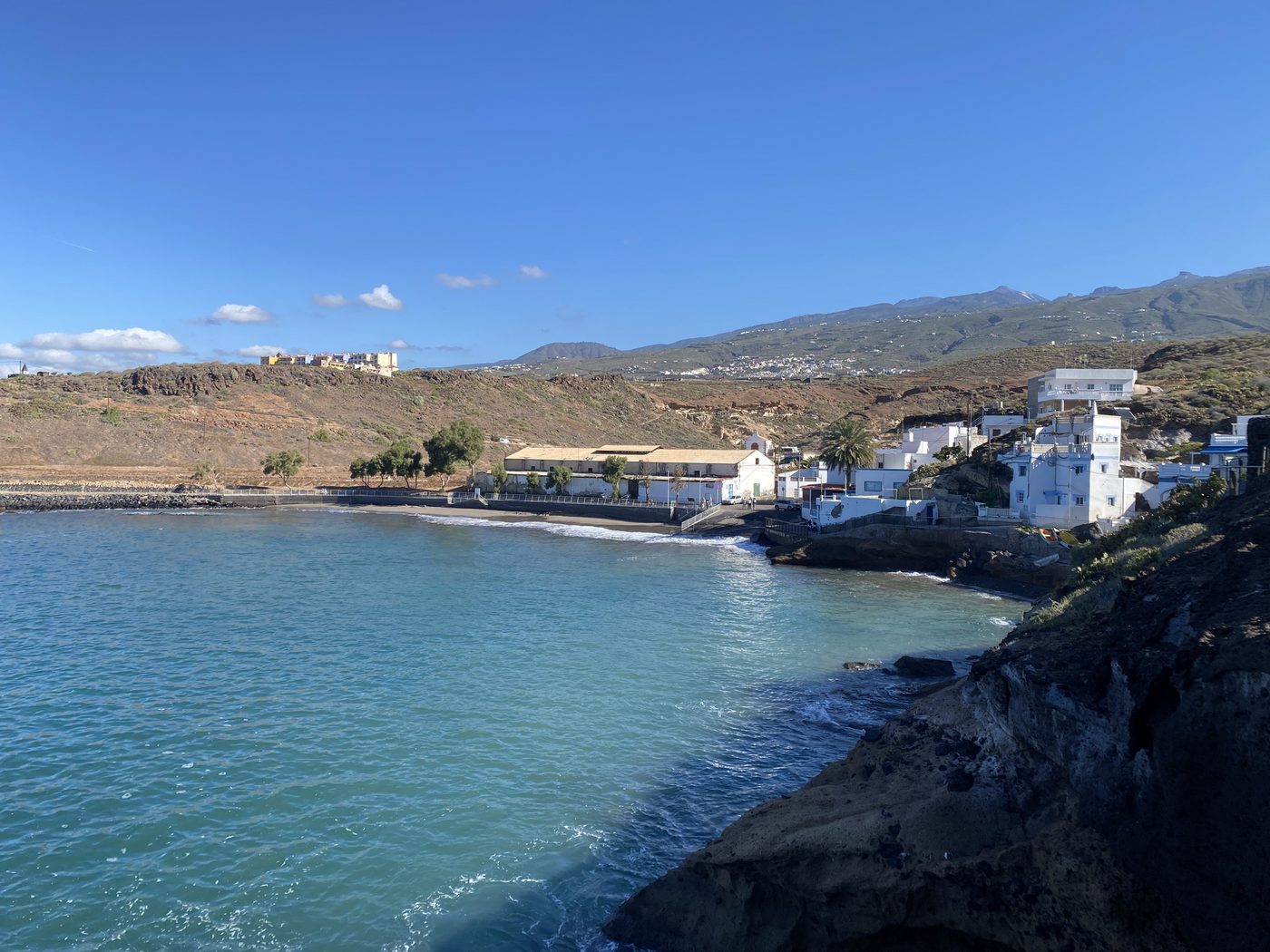
This stretch of coast lay within the old menceyato of Adeje. Archaeological surveys between La Caleta and the boundary with Guía de Isora have found the remains of shepherds' huts on headlands near the ravines, outcrops of obsidian worked in aboriginal times and, at El Puertito, the remains of a hut with fine engravings scratched on the rocks beside it.45 The nearest landing place was that small cove, El Puertito or Pris de Adeje, which documents of the sixteenth century already mention as a place to load orchil, the lichen used for dye, and which an account of 1780 described as good enough for small boats, though open to the winds.6 The nearby village of Armeñime carries a name that also appears in the legends collected by the nineteenth-century ethnographer Juan Bethencourt Alfonso, where Armeñime is a Guanche prince who fought his own nephew for the throne of Adeje.6
In the twentieth century the land behind the coast was farmed for export. Banana estates were already working in western Adeje in 1915, when the Harvard anthropologist Earnest Hooton stayed at the Fyffes plantation at Hoya Grande and excavated a burial cave with eight bodies in the Barranco de las Barandas, just north of Armeñime, until the authorities stopped him.4 In the 1950s and 1960s the slopes were cut into terraces for tomatoes; many were later abandoned, and some were replanted with bananas in the 1970s and 1980s, partly by Canarian emigrants returning from Venezuela.5
A Centre of National Tourist Interest
In 1963 Franco's government passed a law on Centres and Zones of National Tourist Interest (CITN). It offered private developers who built complete, well-equipped holiday towns a fast track through planning and a set of incentives, in exchange for a higher standard than was usual at the time. In practice the zones were never created and the law served mostly to approve individual resorts.2
Callao Salvaje was one of them. On 24 July 1969 a decree signed by Franco and by his tourism minister, Manuel Fraga Iribarne, declared "the planned development called Callao Salvaje" in the municipality of Adeje a Centre of National Tourist Interest. The application had been made by the architect Luis Cabrera Sánchez-Real on behalf of Juan Esquivel Castellano; the centre covered seventy hectares, and its promotion plan had been approved by the ministry earlier that month.1 The decree granted the developers priority access to official credit, declared their projects to be of exceptional public utility, allowed them to obtain the seashore within the estate without the usual public auction, and authorised the compulsory sale of two small neighbouring plots if their owners did not build in line with the plan within two years.1 Cabrera was one of the leading Canarian architects of the time and was working in those same years with Javier Díaz-Llanos and Vicente Saavedra on Ten Bel, the experimental holiday town at the other end of the south coast.7
Other Tenerife projects declared CITN in those years included the cliffs of Los Gigantes in Santiago del Teide (1964) and El Guincho in San Miguel de Abona (1967), as well as two beach developments in Santa Cruz.23
From plan to place
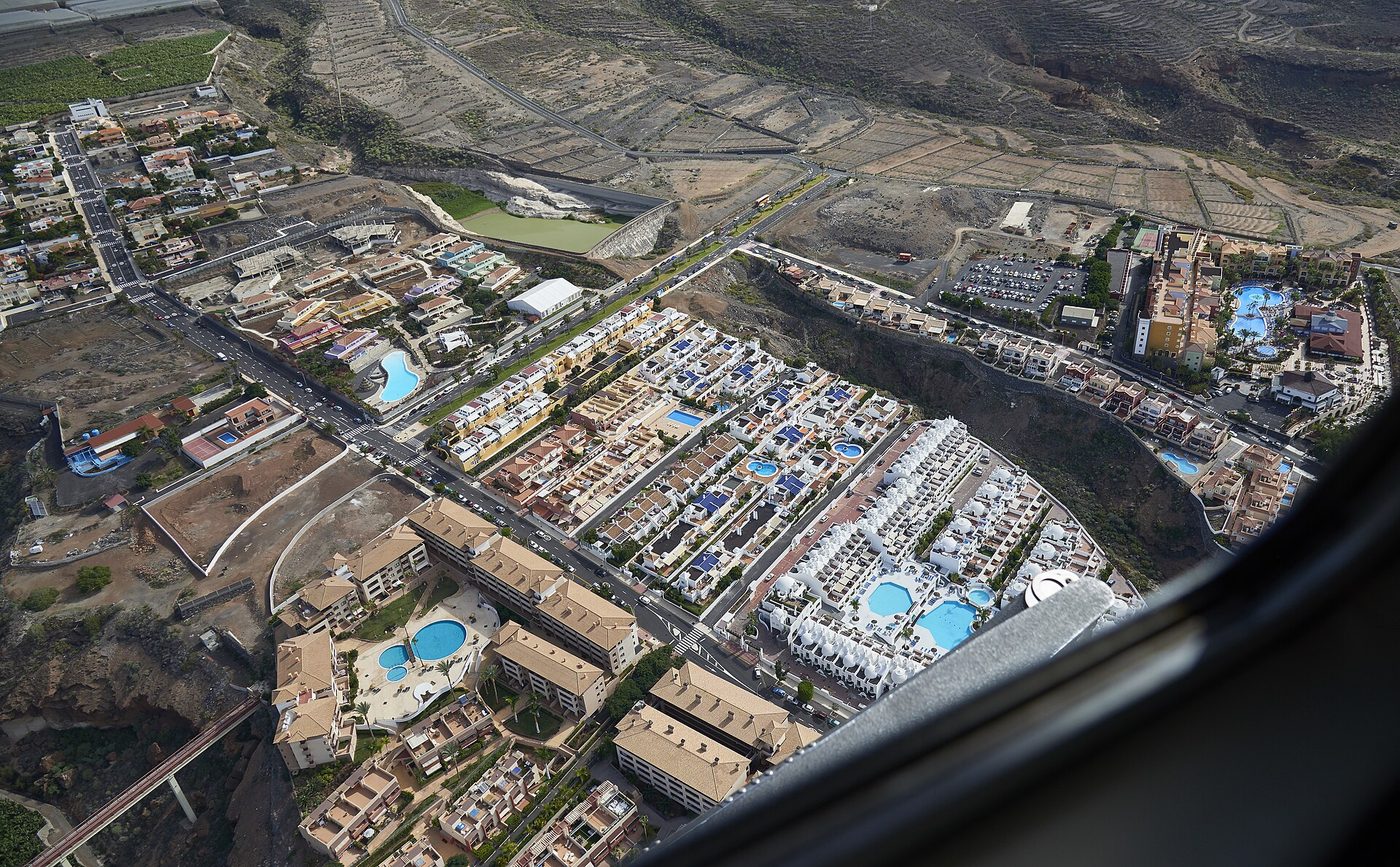
The plan was one of a wave of tourist projects that Adeje approved on rural estates between 1968 and 1973.3 Building came slowly. When the town's planning rules were reviewed in 1982 and 1986, Callao Salvaje was listed with Costa Adeje, La Caleta and Playa Paraíso as urban land for tourism, and the 1986 reclassification opened space for tens of thousands of new tourist beds across the municipality.3 The archaeologists who surveyed the coast between 2004 and 2009 noted how hotels, apartment complexes and golf courses had replaced the farmland of the 1950s, and how some small coastal sites recorded in 1988 had disappeared.5 Today Callao Salvaje is a residential and holiday town of apartment blocks on the cliffs, with banana terraces still visible above it. Nearby, at El Puertito, a large new resort project was partly halted in 2022 after rock engravings and a rare endemic plant were found on the site.4
Notes and sources
- 1.Decreto 2039/1969, de 24 de julio, por el que se declara Centro de Interés Turístico Nacional el complejo denominado «Callao Salvaje», situado en el término municipal de Adeje, Boletín Oficial del Estado, 16 September 1969. boe.es
- 2.L. Galiana Martín and D. Barrado Timón, "Los centros de interés turístico nacional y el despegue del turismo de masas en España", Investigaciones Geográficas 39 (2006), pp. 73-93 (including the list of approved centres). redalyc.org
- 3.C. García-Blanco Chávez, "Turismo y territorio. La transformación del sur de Tenerife (1960-2018)", Territorios en Formación 23 (2025), DOI 10.20868/tf.2025.23.5625. polired.upm.es
- 4.A. Mederos Martín, G. Escribano Cobo and V. Valencia Afonso, "Hábitat aborigen y grabados rupestres en el municipio de Adeje (Tenerife, islas Canarias). (I). Historia de la investigación", Anuario de Estudios Atlánticos 70 (2024), 070-001. revistas.grancanaria.com
- 5.A. Mederos Martín, G. Escribano Cobo and V. Valencia Afonso, "Hábitat aborigen y grabados rupestres en el municipio de Adeje (Tenerife, islas Canarias) (II). La prospección arqueológica", Anuario de Estudios Atlánticos 71 (2025), 071-011. revistas.grancanaria.com
- 6.A. Mederos Martín and G. Escribano Cobo, "Prospección arqueológica de La Caleta de Adeje (Tenerife, Islas Canarias)", Revista de Historia Canaria 198 (2016), pp. 177-229. riull.ull.es
- 7.Materia contemporánea. Javier Díaz-Llanos y Vicente Saavedra. 50 años de arquitectura, exhibition catalogue, TEA Tenerife Espacio de las Artes. teatenerife.es
- 8.INVOLCAN, Geoturismo urbano de Tenerife: Candelaria, 2019 (bilingual leaflet in which callaos is rendered as "pebbles"). tfgeoturismo.involcan.org
What's on in Adeje now →
Fiestas, concerts and events from the town hall agenda, updated daily.
More towns in the series
La Laguna · Towns of Tenerife
San Cristóbal de La Laguna: a town planned for peace
Garachico · Towns of Tenerife
Garachico: the port the volcano took
Bajamar · Towns of Tenerife
Bajamar and Punta del Hidalgo: La Laguna's shore
Candelaria · Towns of Tenerife
Candelaria: the shrine on the shore
Santa Cruz de Tenerife · Towns of Tenerife
Santa Cruz: from army camp to capital
La Orotava · Towns of Tenerife
La Orotava: a town drawn with a cord
Adeje · Towns of Tenerife
Adeje: the kingdom, the fortress and the marquises
La Caleta · Towns of Tenerife
La Caleta: Adeje's old harbour
Los Cristianos · Towns of Tenerife
Los Cristianos: the south's harbour
Las Galletas · Towns of Tenerife
Las Galletas: salt, fish and a garden city
Playa de las Américas · Towns of Tenerife
Playa de las Américas: a resort from scratch
Playa Paraíso · Towns of Tenerife
Playa Paraíso: a paradise on paper
Guía de Isora · Towns of Tenerife
Guía de Isora: from Teide to the sea
Playa San Juan · Towns of Tenerife
Playa San Juan: Guía de Isora's harbour
Alcalá · Towns of Tenerife
Alcalá: a fishing village on the lava
Puerto Santiago · Towns of Tenerife
Puerto Santiago and Los Gigantes: life below the cliffs
El Médano · Towns of Tenerife
El Médano: the harbour under the red mountain
Icod de los Vinos · Towns of Tenerife
Icod de los Vinos: the dragon tree and the cove of San Marcos
Puerto de la Cruz · Towns of Tenerife
Puerto de la Cruz: from wine port to the first resort
San Juan de la Rambla · Towns of Tenerife
San Juan de la Rambla: a village on the badlands
Buenavista del Norte · Towns of Tenerife
Buenavista del Norte: a planned town at the end of the island