
La Orotava · Towns of Tenerife
La Orotava: a town drawn with a cord
The Guanche kingdom of Taoro, the conquerors' favourite farmland, a town founded on paper in 1506, two neighbourhoods divided by wealth and water mills, and a villa that bought its independence from La Laguna. Five centuries of La Orotava.
6 min read · 3 sources · Updated October 2026
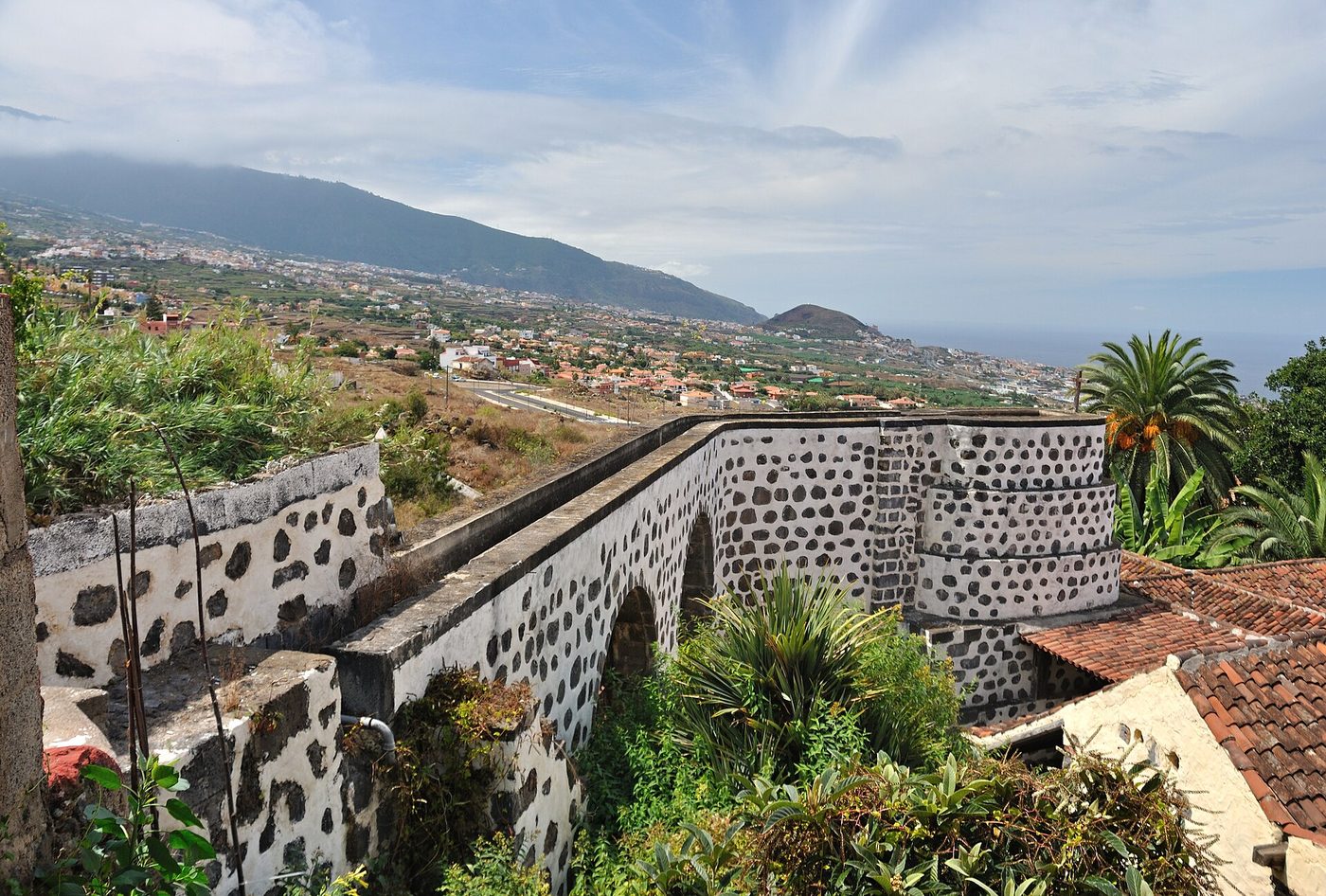
Acueducto de los Molinos · Carlos López-Echeto Marrero, CC BY-SA 3.0 ES
La Orotava is one of the few towns in the Canaries whose birthday can be given to the day. On 29 May 1506 a royal judge stood on a sloping field above the valley, decided where houses could be built and had a councillor stretch cords across the ground to mark the first streets.1 The town that grew there became the second most populous on the island, the home of its proudest families and, by the end of the seventeenth century, a villa that had paid the Crown to stop answering to La Laguna.1
The best land on the island
Before the conquest the valley belonged to the menceyato of Taoro, which the guide of the Canary Islands Volcanological Institute (INVOLCAN) describes as the most powerful of the nine Guanche kingdoms; the name La Orotava comes from the Guanche Arautaba.3 After the surrender of 1496 the valley was the prize everybody wanted. Alonso Fernández de Lugo began sharing out the island's land and water on 5 November 1496 and kept the Taoro valley for his relatives and allies, as well as a large estate for himself: he regarded it as the best farmland on Tenerife.1
For the first few years there was no town at all, just scattered settlers on their new lots. On 10 January 1502 Lugo held a council meeting in the valley, at the estate of Fernando de Castro, and made the first large collective distribution of land, mostly around the district of Higa, today's La Perdoma. Each beneficiary had to build a "lived-in house" and stay with his family for five years before he could sell.1 Water came next: in February 1502 Lugo commissioned two Portuguese, Juan Fernández and Hernando de Castro, to bring a channel down from the springs of Aguamansa.1
Founded with a cord
The shares were so unequal that complaints reached the King. In 1504 Ferdinand sent the governor of Gran Canaria, Lope de Sosa, to investigate, and a special judge, Juan Ortiz de Zárate, was appointed to correct Lugo's distribution. At a hearing in La Laguna in April 1506 the settlers of Orotava had one complaint in common: their place had no plan and not even streets, because the landowners would not give up a strip of ground to connect their estates.1
Ortiz de Zárate arrived in the valley on 15 May 1506 with a surveyor and a water measurer. A week later twenty-three residents asked him for building plots around the little church of La Concepción, which had stood there since 1498 and had a resident priest since 1503. On 29 May he decreed that the land between the last sugar mill and the head of the cane fields would be reserved for houses, cancelling the grants of anyone who held it. The councillor Diego de Mesa then laid out the streets with cords: plots of 40 by 80 feet, streets 25 feet wide, and houses to be finished by the following feast of St John.1 That act, the town's own protection plan argues, is the real foundation of La Orotava as a town.1
Upper town, lower town
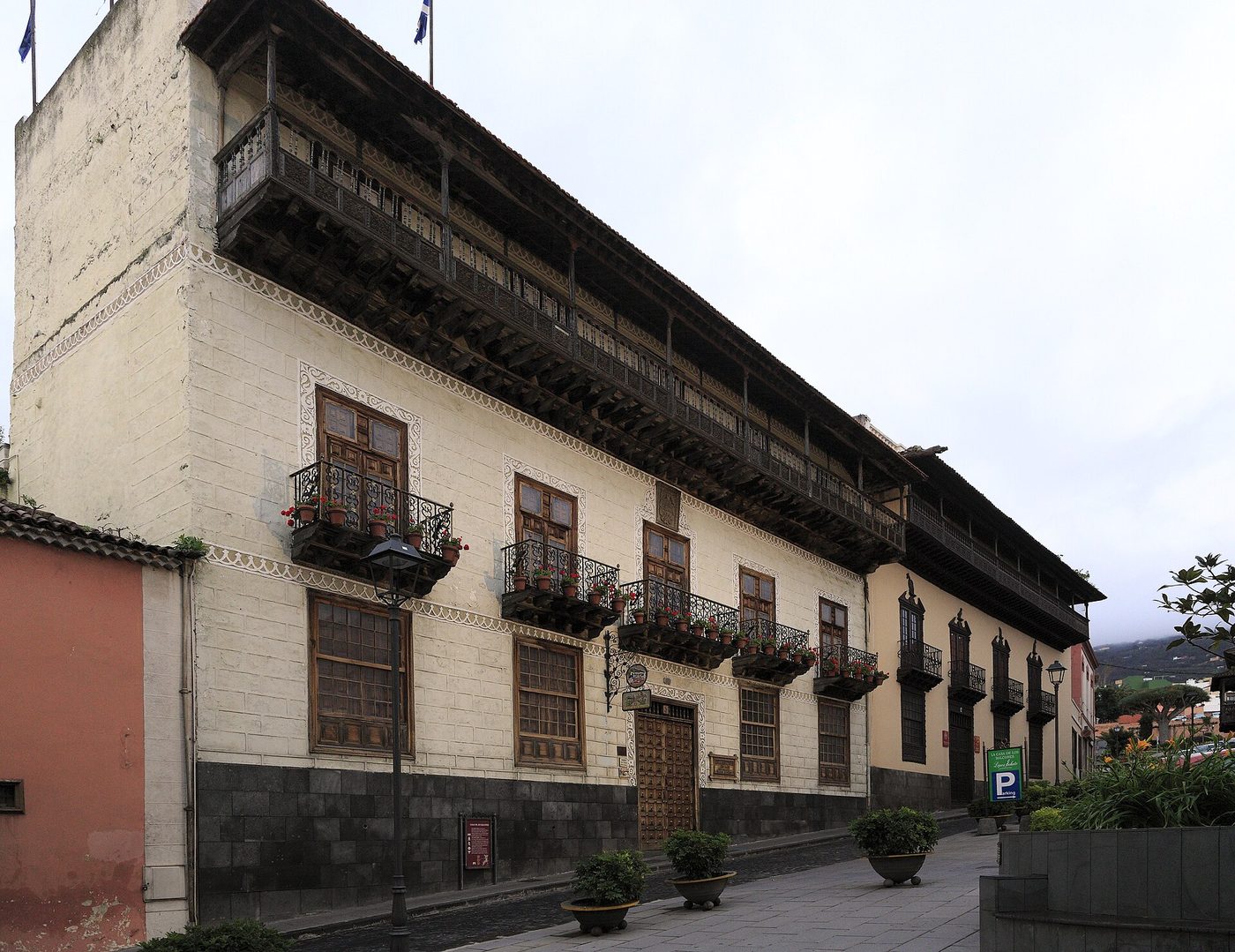
The new town climbed the slope in an amphitheatre between two ravines. Its leading families built along a spine that ran from the sea side up past the church: the streets now called Cólogan, Colegio and San Francisco, where the houses of the Monteverde, Ponte and Benítez de Lugo families still stand. In 1510 Bartolomé Benítez founded the hermitage of San Lorenzo, the first of a ring of convents that would earn it the nickname of "the Escorial of the Canaries".1 Hermitages marked the edges of the town: Santa Catalina (1553), the Carmen or Franchi chapel (1558), San Roque (1594) and La Candelaria del Lomo (1689).1
The upper town, the Villa de Arriba or El Farrobo (a Portuguese word), had a different origin. Around 1500 it was a single sugar estate belonging to the Genoese Tomás Justiniano. When sugar declined, undercut in the 1590s by Brazil, the estate passed to the Valcárcel family, and Francisco de Valcárcel divided it into small plots that he sold to farm workers and craftsmen. Their houses lined the channel that brought water down the hill, with its string of mills grinding grain; the channel became the street.1 The church of San Juan Bautista started in 1608 as a small chapel, 70 feet by 40, built through an agreement between a confraternity of farm labourers and Valcárcel, and became a parish in 1681. After seventeen years of argument the bishopric split the town in two in 1684: 2,919 people for La Concepción and 3,840 for San Juan.1
Up to thirteen mills worked along that channel. Built first in wood and rebuilt in masonry from the late eighteenth century, ten survive, from the Villa de Arriba down past the Plaza de San Francisco.2
A villa of its own
Growth was spectacular. Around 1506 the place had perhaps a hundred inhabitants; by 1561 it had 526 households and 2,575 people, and by 1688 more than 9,000, which made La Orotava the second town of Tenerife.1 Convents multiplied: the Dominicans around 1592, the Poor Clares of San José in 1601, San Nicolás, and the Augustinians in 1648.1 In 1648, after long negotiations and payments to the Crown led by Juan Francisco de Franchy y Alfaro, a royal charter made La Orotava a villa exenta, with its own jurisdiction separate from La Laguna. At that time the villa still included its harbour, the Puerto de la Orotava, which would only become independent in 1813 as Puerto de la Cruz.1
Standing still, and why it helped
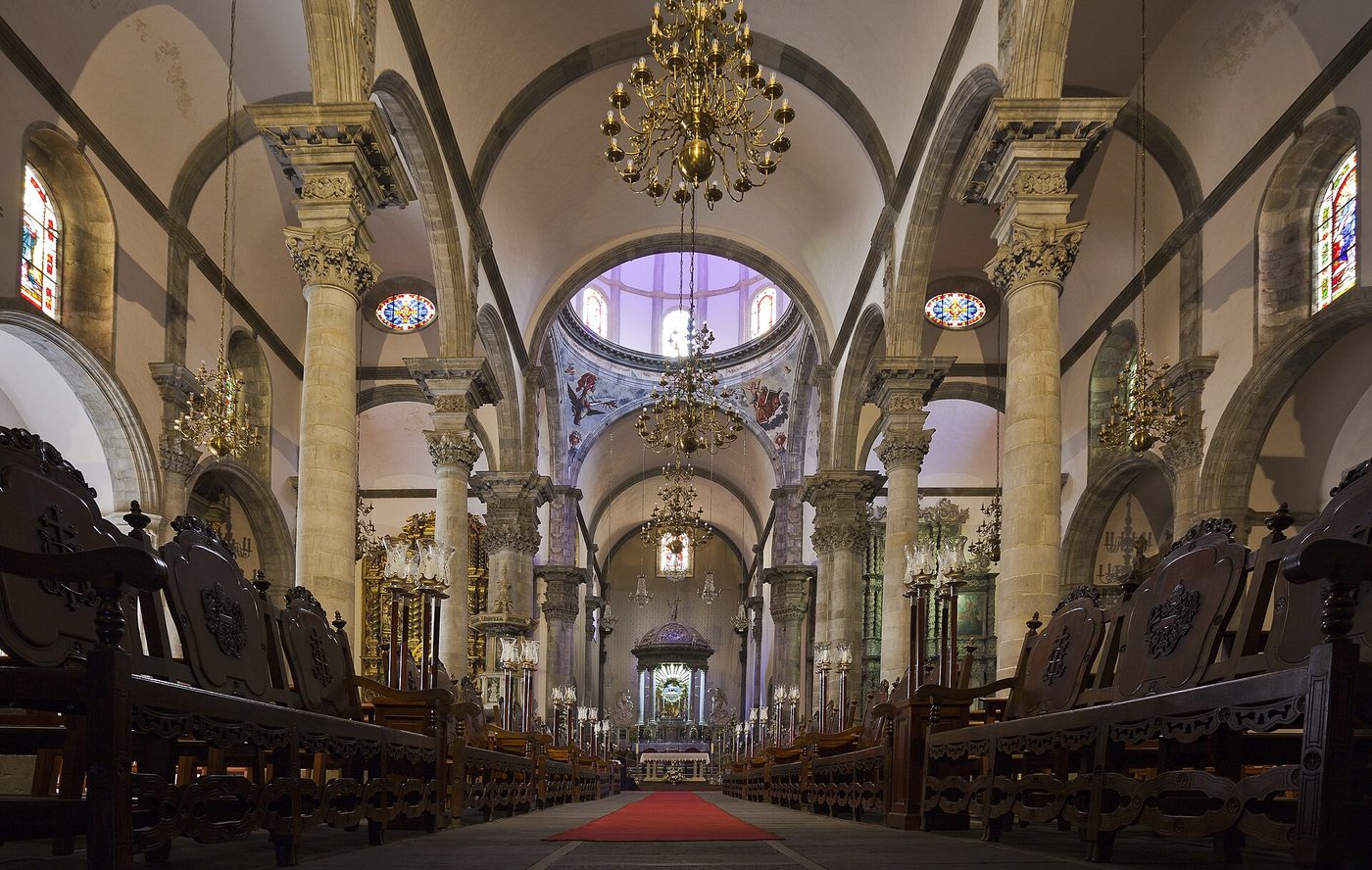
After that golden age the town stopped growing. Hard times in the eighteenth century meant that owners repaired and rebuilt on the same plots instead of expanding, and the street plan of the seventeenth century survived almost untouched.1 The parish church of La Concepción, the third on the site, was finished in 1788 with twin towers, a dome and a marble tabernacle brought from Genoa.2 In 1823 the sculptor Fernando Estévez designed the town's new cemetery, reusing the portal of the vanished convent of San José for its chapel.2
Prosperity returned with the banana in the early twentieth century, when shopkeepers rebuilt the Calle del Calvario, the entrance to the town, in an eclectic style with shop windows.1 Then came the Civil War and a long recession. When mass tourism arrived in the 1960s it went to the coast, to Puerto de la Cruz, and the town's planners later saw that as a stroke of luck: without hotels or speculation, the historic centre was left alone. La Orotava had no general town plan until 1963, a special plan for its old town in 1976 and its first modern suburb, La Duquesa, from the same year.1 The historic centre was recognised in 1976 and its boundaries were fixed in 1999 and 2005.2
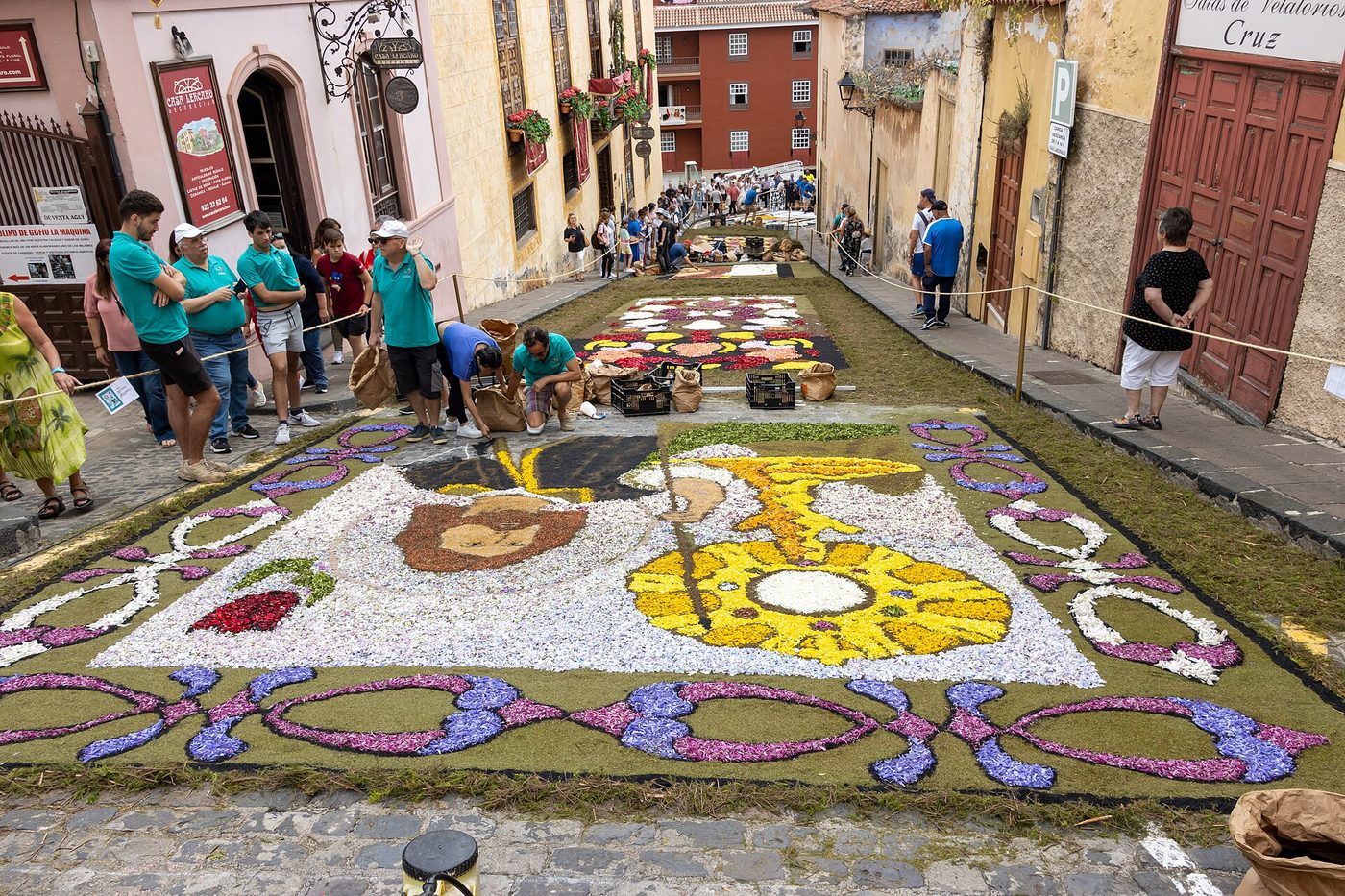
The best-known custom of the town is younger than its streets. In the middle of the nineteenth century the Monteverde family laid a carpet of flowers outside their house, behind La Concepción, for the Corpus Christi procession. The idea spread, and from 1919 a great tapestry made of coloured sands from Teide began to be laid on the square in front of the town hall. It is now the highlight of the town's main fiestas.2
Notes and sources
- 1.Ayuntamiento de La Orotava, Plan Especial de Protección del Conjunto Histórico de la Villa de La Orotava. Memoria, final approval document, 2009, chapter "Origen y evolución del centro urbano" and section on historical demography. The chapter is based on the land grant records, Leopoldo de la Rosa Olivera and the parish records. laorotava.es
- 2.Cabildo de Tenerife, Patrimonio Histórico de Tenerife. Catálogo de Bienes de Interés Cultural, 2018 (entries for the Villa de La Orotava, La Concepción, the Acueducto de los Molinos, the municipal cemetery and the Corpus carpets). tenerife.es
- 3.INVOLCAN, Geoturismo urbano de Tenerife: La Orotava, 2019. tfgeoturismo.involcan.org
What's on in La Orotava now →
Fiestas, concerts and events from the town hall agenda, updated daily.
More towns in the series
La Laguna · Towns of Tenerife
San Cristóbal de La Laguna: a town planned for peace
Garachico · Towns of Tenerife
Garachico: the port the volcano took
Bajamar · Towns of Tenerife
Bajamar and Punta del Hidalgo: La Laguna's shore
Candelaria · Towns of Tenerife
Candelaria: the shrine on the shore
Santa Cruz de Tenerife · Towns of Tenerife
Santa Cruz: from army camp to capital
Adeje · Towns of Tenerife
Adeje: the kingdom, the fortress and the marquises
La Caleta · Towns of Tenerife
La Caleta: Adeje's old harbour
Los Cristianos · Towns of Tenerife
Los Cristianos: the south's harbour
Las Galletas · Towns of Tenerife
Las Galletas: salt, fish and a garden city
Playa de las Américas · Towns of Tenerife
Playa de las Américas: a resort from scratch
Callao Salvaje · Towns of Tenerife
Callao Salvaje: a resort by decree
Playa Paraíso · Towns of Tenerife
Playa Paraíso: a paradise on paper
Guía de Isora · Towns of Tenerife
Guía de Isora: from Teide to the sea
Playa San Juan · Towns of Tenerife
Playa San Juan: Guía de Isora's harbour
Alcalá · Towns of Tenerife
Alcalá: a fishing village on the lava
Puerto Santiago · Towns of Tenerife
Puerto Santiago and Los Gigantes: life below the cliffs
El Médano · Towns of Tenerife
El Médano: the harbour under the red mountain
Icod de los Vinos · Towns of Tenerife
Icod de los Vinos: the dragon tree and the cove of San Marcos
Puerto de la Cruz · Towns of Tenerife
Puerto de la Cruz: from wine port to the first resort
San Juan de la Rambla · Towns of Tenerife
San Juan de la Rambla: a village on the badlands
Buenavista del Norte · Towns of Tenerife
Buenavista del Norte: a planned town at the end of the island