
Candelaria · Towns of Tenerife
Candelaria: the shrine on the shore
A cave, a statue that came from the sea and a village of fishermen and potters that grew up around it. How Candelaria became the spiritual centre of the Canary Islands, lost its Virgin to a flood in 1826 and rebuilt itself around a new one.
8 min read · 5 sources · Updated October 2026
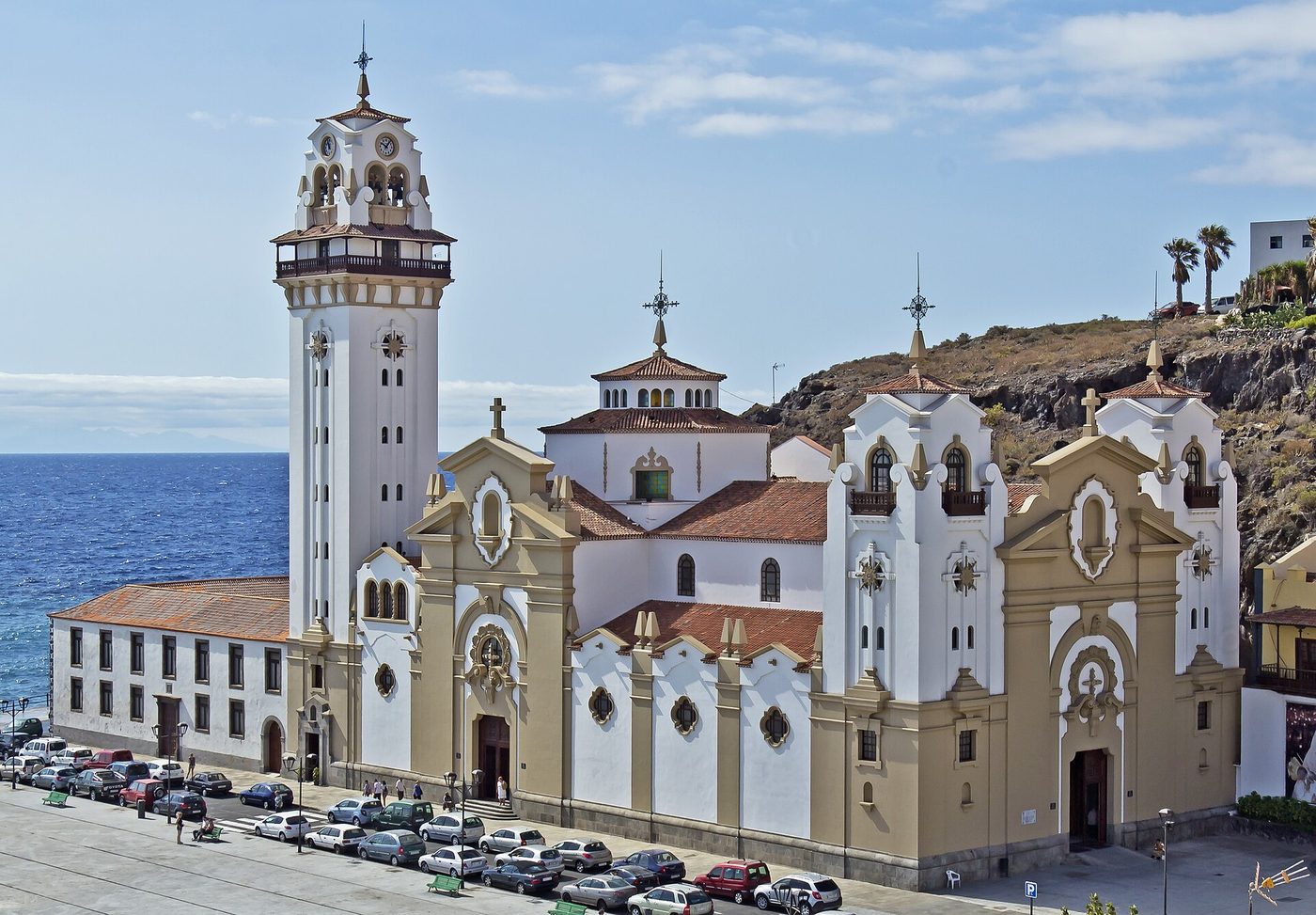
Basílica de Candelaria · Koppchen, CC BY 3.0
Most Canarian towns grew around a church. Candelaria grew around a story. Long before Castile conquered Tenerife, the tradition goes, two Guanche shepherds found a wooden figure of a woman holding a child on a beach in the kingdom of Güímar. That figure became the Virgin of Candelaria, patroness of the whole archipelago, and the small coastal settlement that grew up to look after her is one of the oldest on the island. It was also, for most of its history, one of the most modest.1
A legend between two worlds
The accounts of the apparition were written down from the sixteenth century onwards, above all by the Dominican friar Alonso de Espinosa, whose history of the image was printed in Seville in 1594. In the version that became canonical, the figure appeared on the beach of Chimisay, was carried first to a cave in the ravine of Chinguaro and was later moved to the cave of Achbinico, on the shore where Candelaria now stands.1 Historians treat these texts as devotional literature rather than as eyewitness records, but they agree on what the story reveals: a period of contact, before and during the conquest, between the Guanches of the south-east and the first Christian missionaries.1
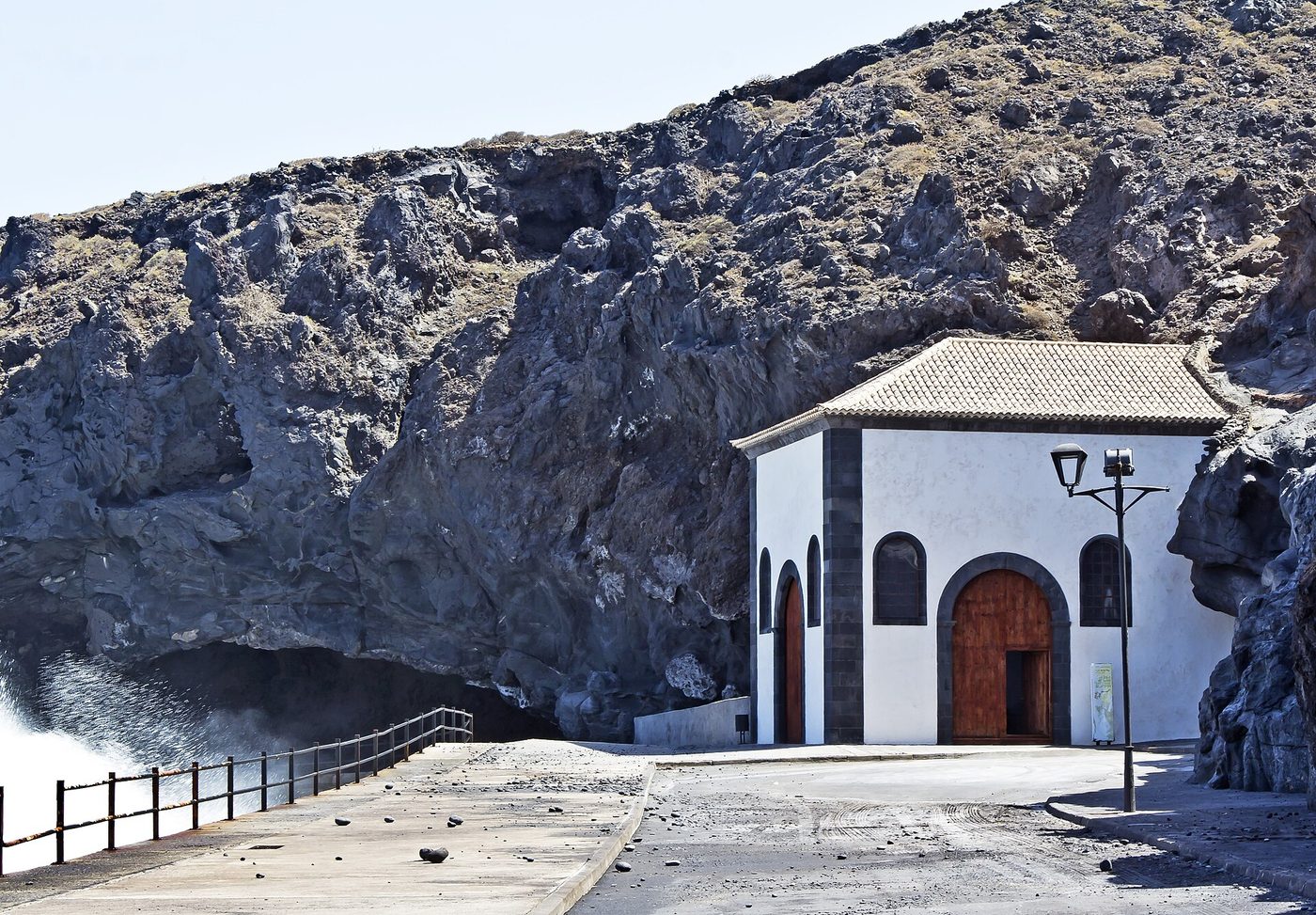
Later writers added a founding legend for the village itself. According to José Rodríguez Moure, a baptised Guanche called Antón was made keeper of the cave, and the elders who joined him settled in the caves nearby, becoming the first inhabitants of Candelaria. Other authors stress that, before the image arrived, this stretch of dry coast had no permanent population at all and was visited only by shepherds; living on the shore was risky, because raiders came by sea to steal livestock.1 What the documents do show is that the cave of Achbinico, later called the cave of San Blas, was used for Christian worship from the very start: the eighteenth-century historian Viera y Clavijo records that a tabernacle and font were placed there in 1496, the year the conquest ended.1
A Guanche village
For most of the sixteenth century Candelaria remained small and unsettled. The parish moved back and forth between Candelaria and Güímar, and a mid-century report described the place where the image stood as an empty spot by the sea.1 Yet it had a distinctive population. Notarial records from the 1570s and 1580s show that the village was inhabited mostly by native Tenerifans, many of them from other former kingdoms who had moved there after the conquest, and that its mayors were themselves of Guanche descent. They held a privilege they defended fiercely: the right to carry the image in procession, later confirmed by King Philip III.1 People lived in caves and in small dry-stone houses, a way of building that could still be seen in the nineteenth century.1
The numbers were tiny. A grain census of 1552 counted 148 people, and in 1561 the figure of 249 included Güímar and Arafo as well.1
Pilgrims, friars and the Cabildo
Candelaria mattered far beyond its size. The island's ordinances provided for an official procession every 2 February, the feast of the Purification, from La Laguna to the Virgin's "holy house", and in 1576 the island council allowed anyone to sell food freely in Candelaria for three days before and after the feast: a pilgrimage had become a fair.1 In bad years the image travelled the other way. It was taken to La Laguna in 1554 for safety and in 1562 to pray for rain after a drought, a custom that has lasted into modern times.1
Custody of the image was disputed from the start. In 1530 the bishop entrusted the sanctuary to the Dominicans, to the anger of the secular clergy of La Laguna, and on 4 December 1534 the Cabildo of Tenerife gave the friars the hermitage and the land around it, from the cliffs to the sea, a grant confirmed by the Crown a year later.2 For the next three centuries the friars, the island council, the parish clergy and the native families argued over who could carry the Virgin, where she should live and who should pay for her.2
The arguments were not only about precedence. The sanctuary stood on an exposed beach, beneath a cliff and at the mouth of a ravine. In the seventeenth century, fear of North African raiders led to repeated proposals to move it inland; in 1668 most councillors voted to rebuild it at La Paz, above Puerto de la Cruz, but riots in La Laguna stopped the plan and the image went back to its shore.2 In February 1705, while the Cabildo was in Candelaria for the feast, earthquakes from the eruption at Güímar shook the town and revived the debate.2
The village fills out
From the later seventeenth century Candelaria began to look like a town. From 1668 the Cabildo built a house to lodge its councillors during the February feast, and leading families followed with houses of their own, many of two storeys, on plots the Dominicans let at low rents. They lined the street of San Blas between the convent and the cave, the route of the processions, alongside lodgings for pilgrims.1 Up on the slope, around the church of Santa Ana, the permanent population replaced its cave dwellings with modest houses.1
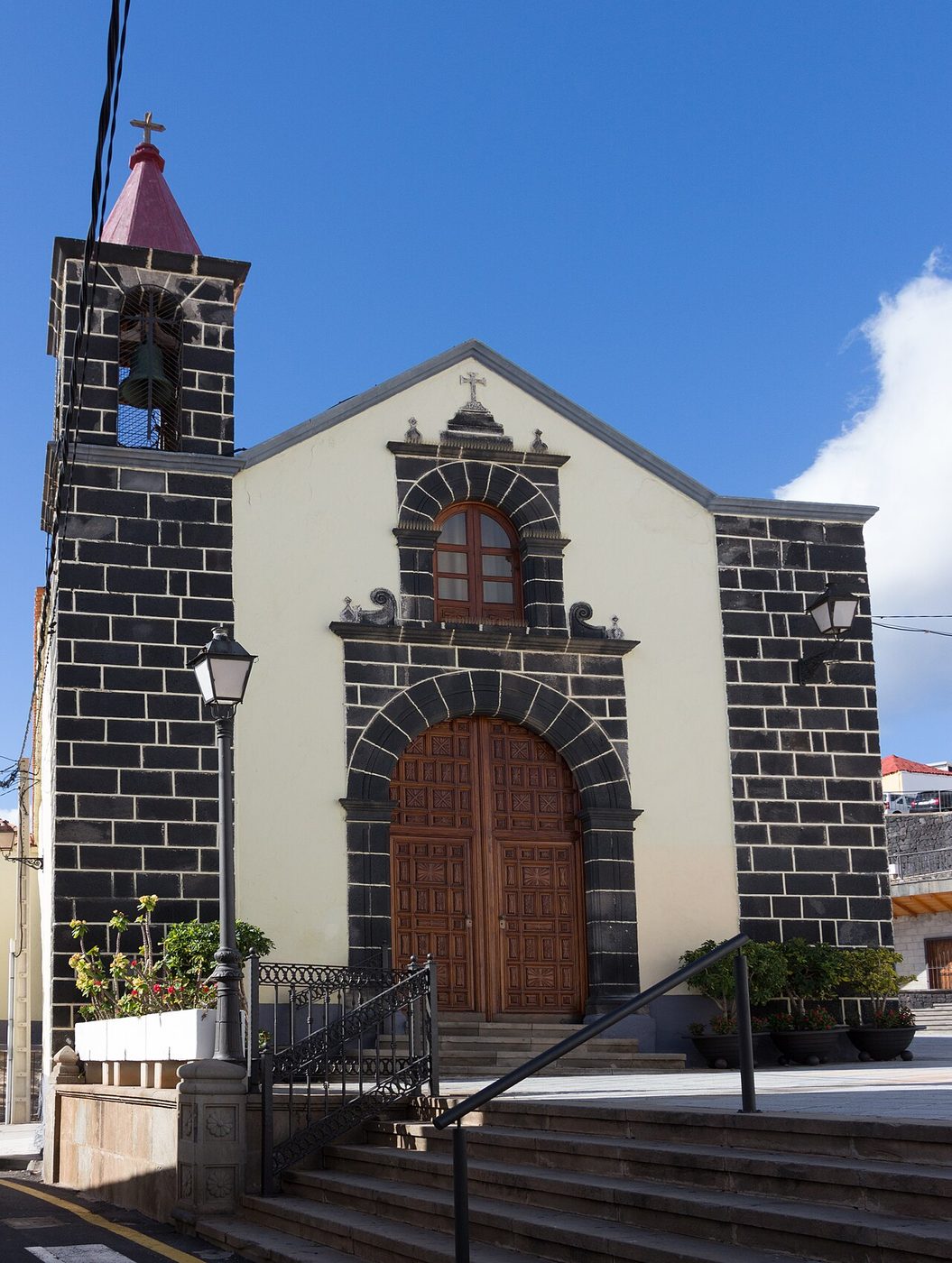
By 1629 a synodal survey counted some 200 households, perhaps 800 or 900 people, and by the end of the eighteenth century the jurisdiction had more than 2,000 inhabitants. Santa Ana was rebuilt and enlarged in 1769 and became a parish in its own right in 1796.1 Viera y Clavijo described the scene in the 1770s: a "royal" Dominican convent with about 25 friars and a richly furnished church of three naves, guarded by the small castle of San Pedro; above it, a village where the men fished and the women made pottery, jugs and clay vessels that were prized even outside the islands.1
Fire and flood
Then came two disasters in less than forty years. In 1789 fire destroyed the convent. Rebuilding stalled for years while the friars, the Cabildo and the military argued: the engineers objected that a new building would block the line of fire of the San Pedro battery, while some councillors wanted the image moved to La Laguna for good. Only in 1796 did a royal decision allow the friars to rebuild on the old site, and the work lasted until 1808.2
On 7 November 1826 a flash flood came down the ravine, broke into the Virgin's chapel and swept the image into the sea. It was never found.12 The next February the feast was held without a statue, with an oil painting of the lost image in its place. The Dominicans then commissioned a new figure from Fernando Estévez, a sculptor from La Orotava, who began it on 14 May 1827 for 3,000 reales. Estévez did not copy the lost image; he made a new one in his own neoclassical style, which puzzled the faithful at first but soon took the old one's place in their devotion.3 It is his Virgin that is venerated today.
The basilica
The nineteenth century was hard on Candelaria. The French anthropologist René Verneau found a handful of poor houses by the shore, home to fishermen whose wives made pottery, and the confiscation of church property slowed any recovery.1 In 1865 the town had eighteen streets, most of its houses still on the slope around Santa Ana.1 The argument about moving the sanctuary went on until the twentieth century.2
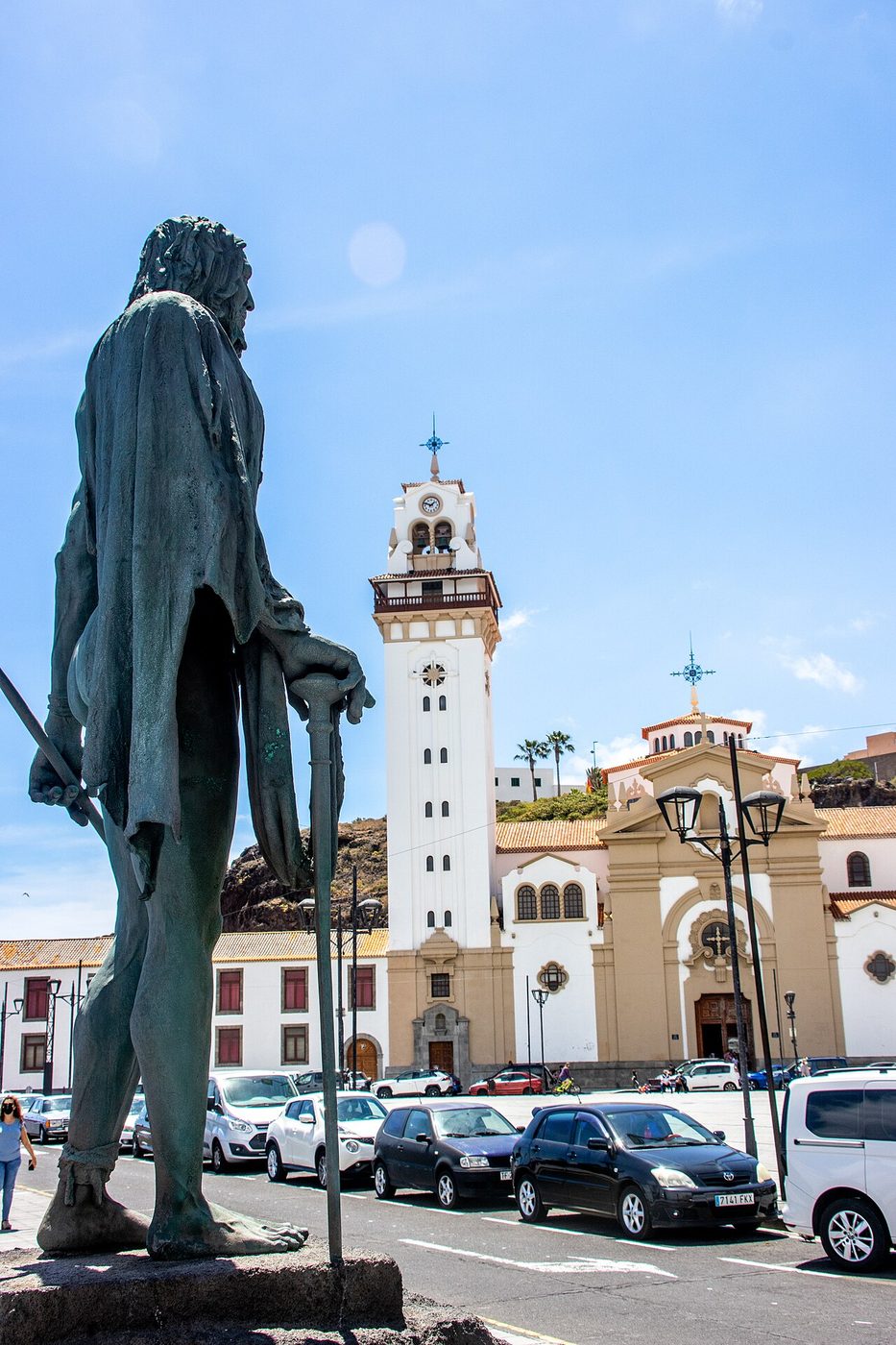
It was settled by building big. In 1948 the new bishop of Tenerife, Domingo Pérez Cáceres, set up a committee with the president of the Cabildo, Antonio Lecuona, and representatives from across the island. The first stone was laid on 2 February 1949 to plans by the architect José Enrique Marrero Regalado; after his death in 1956 his nephew Félix Sáenz Marrero completed the work. The new sanctuary was consecrated on 1 February 1959, with a large mural by José Aguiar behind the altar.3 It is a regionalist building in the post-war "neo-Canarian" manner.14 The great square in front of it, open to the sea, is lined with monumental statues of the Guanche kings by the sculptor José Abad.1
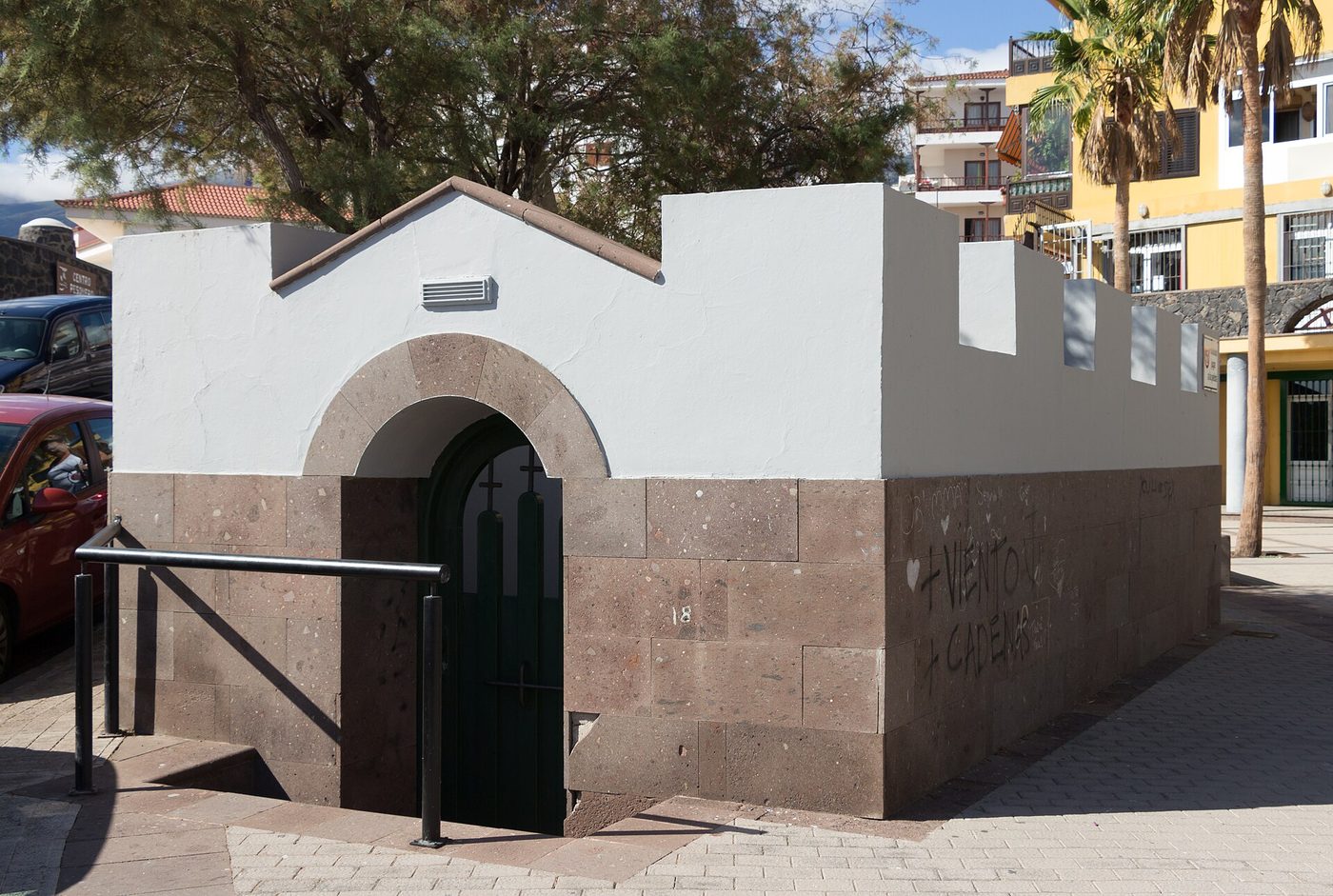
Candelaria remains above all a place of pilgrimage. The old Camino de Candelaria from La Laguna, walked for centuries by pilgrims and by the processions that took the image to the capital, is protected as a historic site, and so is the Pozo de la Virgen, the well where pilgrims drew water on arrival.4 The two great feasts that Viera y Clavijo already described, in February and August, still draw pilgrims from all over the islands.1 The geologists of INVOLCAN add one more layer to the story: the town stands in a valley carved by a giant landslide and later partly refilled by lava, and archaeological remains in the area are more than two thousand years old.5
Notes and sources
- 1.J. S. López García, "El centro histórico de la villa de Candelaria (Tenerife)", Vegueta 5 (2000), pp. 277-289. Draws on Espinosa, Viera y Clavijo, Rodríguez Moure, Rosa Olivera and the travellers Berthelot and Verneau. revistavegueta.ulpgc.es
- 2.J. J. Suárez Acosta and L. González Duque, "La Virgen de Candelaria y el Cabildo de Tenerife: apuntes en torno a una confrontación sesgada", Almogaren 7 (1991), pp. 87-100. Based on the records of the Municipal Archive of La Laguna. dialnet.unirioja.es
- 3.M. J. Riquelme Pérez, La Virgen de Candelaria y sus santuarios, doctoral thesis, Universidad de La Laguna, 1988 (chapters on the iconography after 1826 and on the present sanctuary). riull.ull.es
- 4.Cabildo de Tenerife, Patrimonio Histórico de Tenerife. Catálogo de Bienes de Interés Cultural, 2018 (entries for the sanctuary, the Pozo de la Virgen and the Camino de Candelaria). tenerife.es
- 5.INVOLCAN, Geoturismo urbano de Tenerife: Candelaria, 2019. tfgeoturismo.involcan.org
What's on in Candelaria now →
Fiestas, concerts and events from the town hall agenda, updated daily.
More towns in the series
La Laguna · Towns of Tenerife
San Cristóbal de La Laguna: a town planned for peace
Garachico · Towns of Tenerife
Garachico: the port the volcano took
Bajamar · Towns of Tenerife
Bajamar and Punta del Hidalgo: La Laguna's shore
Santa Cruz de Tenerife · Towns of Tenerife
Santa Cruz: from army camp to capital
La Orotava · Towns of Tenerife
La Orotava: a town drawn with a cord
Adeje · Towns of Tenerife
Adeje: the kingdom, the fortress and the marquises
La Caleta · Towns of Tenerife
La Caleta: Adeje's old harbour
Los Cristianos · Towns of Tenerife
Los Cristianos: the south's harbour
Las Galletas · Towns of Tenerife
Las Galletas: salt, fish and a garden city
Playa de las Américas · Towns of Tenerife
Playa de las Américas: a resort from scratch
Callao Salvaje · Towns of Tenerife
Callao Salvaje: a resort by decree
Playa Paraíso · Towns of Tenerife
Playa Paraíso: a paradise on paper
Guía de Isora · Towns of Tenerife
Guía de Isora: from Teide to the sea
Playa San Juan · Towns of Tenerife
Playa San Juan: Guía de Isora's harbour
Alcalá · Towns of Tenerife
Alcalá: a fishing village on the lava
Puerto Santiago · Towns of Tenerife
Puerto Santiago and Los Gigantes: life below the cliffs
El Médano · Towns of Tenerife
El Médano: the harbour under the red mountain
Icod de los Vinos · Towns of Tenerife
Icod de los Vinos: the dragon tree and the cove of San Marcos
Puerto de la Cruz · Towns of Tenerife
Puerto de la Cruz: from wine port to the first resort
San Juan de la Rambla · Towns of Tenerife
San Juan de la Rambla: a village on the badlands
Buenavista del Norte · Towns of Tenerife
Buenavista del Norte: a planned town at the end of the island