
Las Galletas · Towns of Tenerife
Las Galletas: salt, fish and a garden city
A ravine mouth named in 1516, a lava coast where the Guanches made salt, a fishing village on the edge of the malpaís, and next door Ten Bel, the experimental holiday town of the 1960s. The story of Arona's southern shore.
5 min read · 6 sources · Updated October 2026
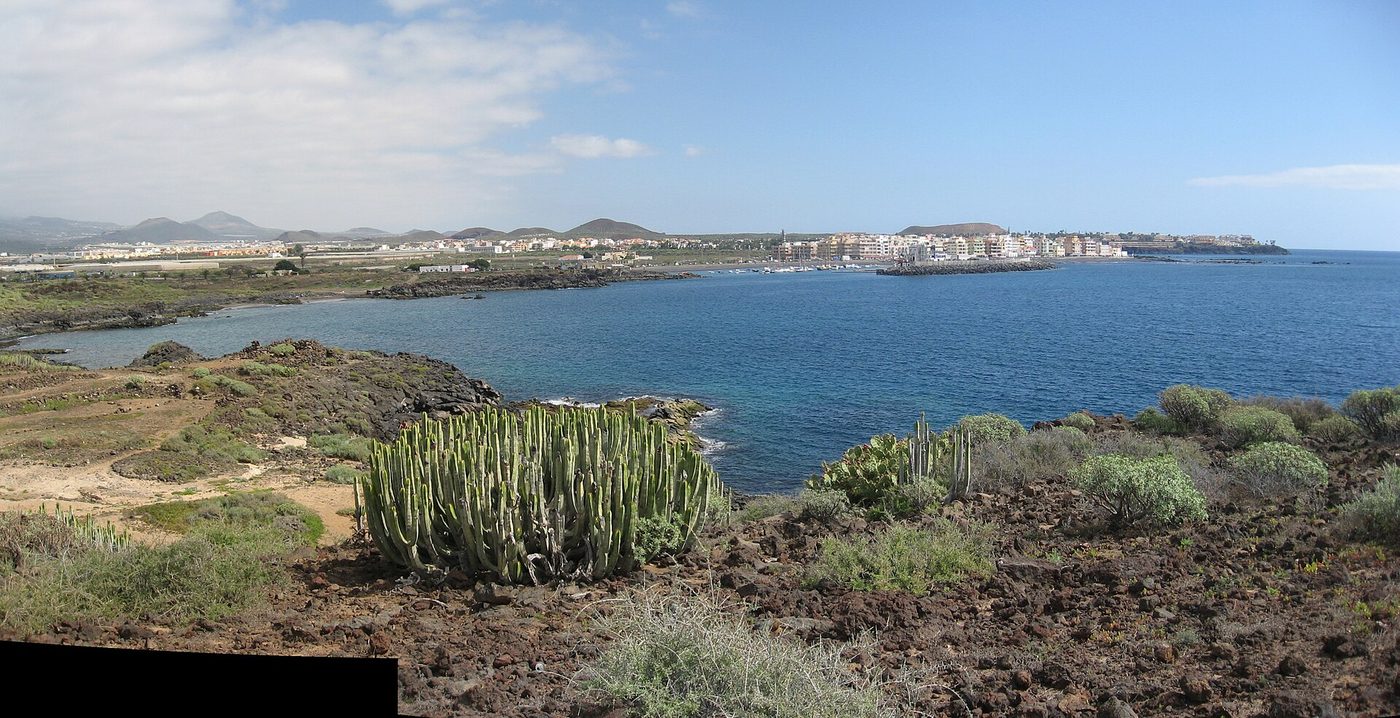
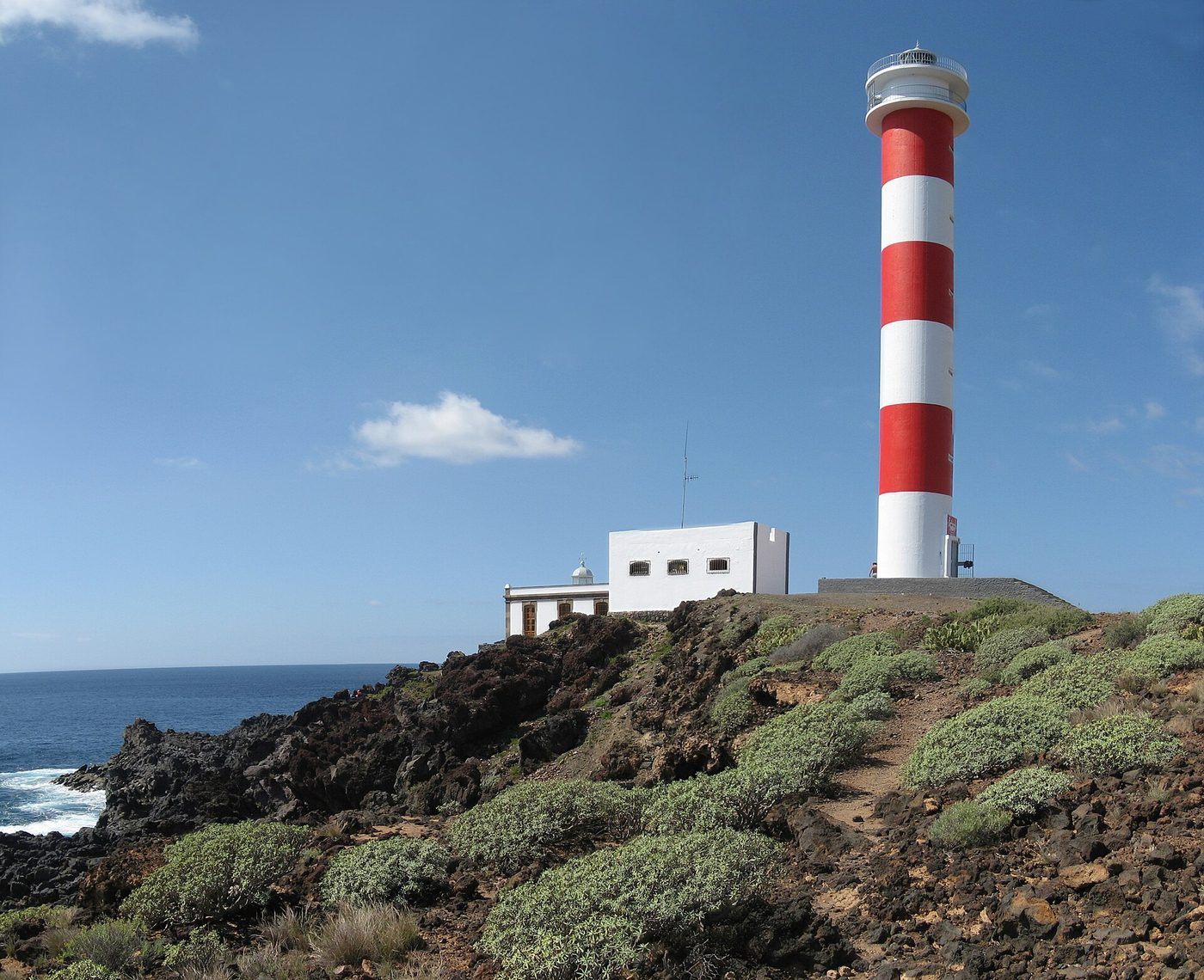
Las Galletas · Mike Peel, CC BY-SA 4.0
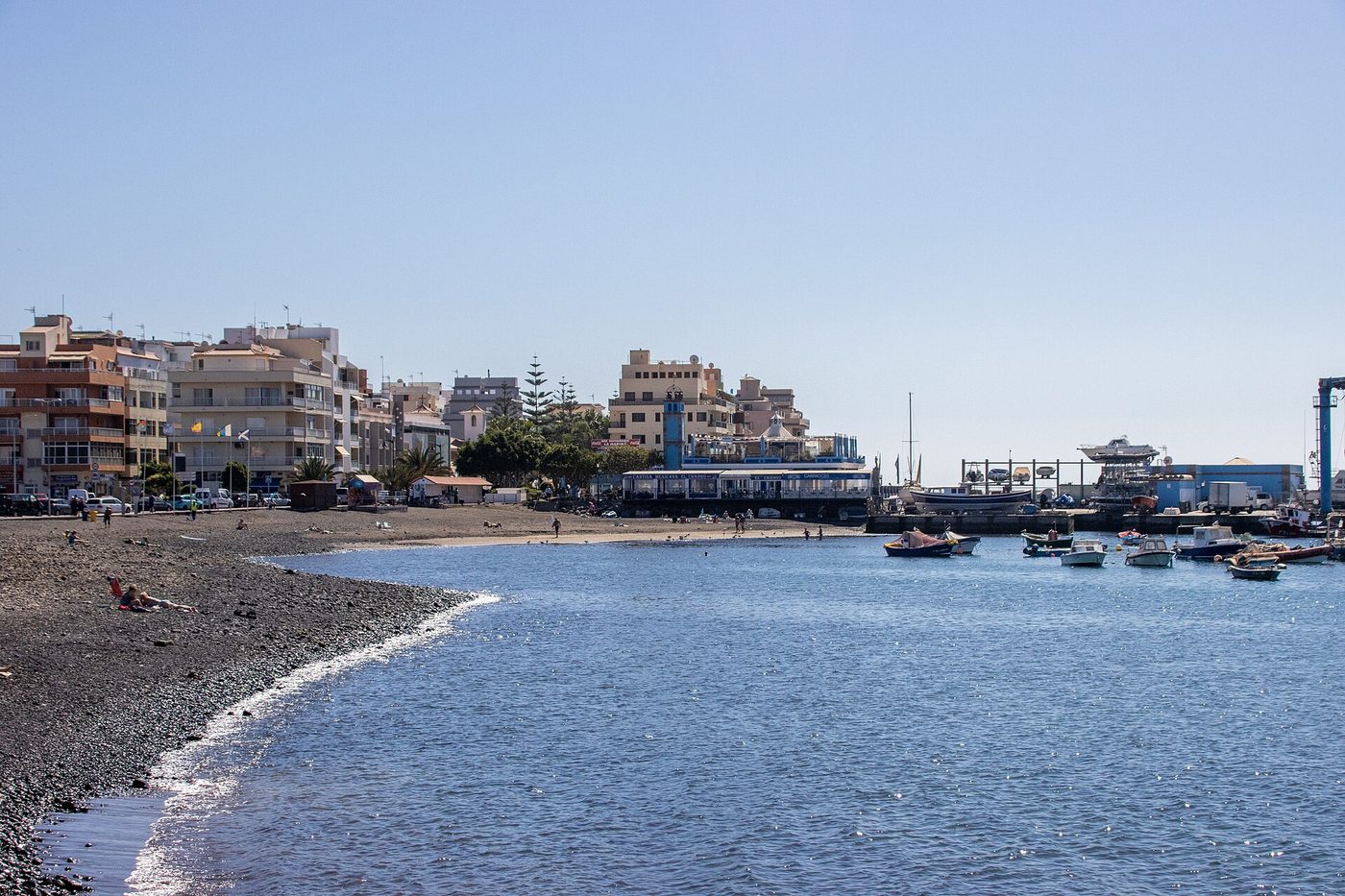
Las Galletas sits at the far southern tip of Tenerife, where a broad platform of old lava runs down to the sea between the Montaña de Guaza and the Montaña Amarilla. It is a small seaside village that became a resort without quite losing its boats. Its history is short on monuments but long on landscape: a malpaís where people made salt for centuries, a ravine that may once have marked a border between Guanche kingdoms, and one of the most admired pieces of tourist architecture in Spain.
A border at the ravine mouth
The name Las Galletas is older than any village. A land grant of 1516 gives an estate in the kingdom of Abona that ran "the whole ravine down to Las Galletas, to the sea", with the small wells beside it and the dwellings of a man called Fernando Guadarteme.1 Which Guanche kingdom this coast belonged to is still argued over. The archaeologists Alfredo Mederos and Gabriel Escribano, weighing the early land grants, propose that the border between the menceyatos of Abona and Adeje followed the Barranco del Río down from the highlands to reach the sea at the beach of Las Galletas.1 They also point to the extraordinary concentration of rock engravings on the hills around the valley of San Lorenzo, inland from Las Galletas, which they read as symbolic markers along that frontier.2
Salt and shells on the malpaís
The lava platform was not empty land. Surveys have counted more than a hundred archaeological sites in the malpaís of Rasca alone, among them dozens of groups of huts; the area is protected as an archaeological zone that combines the malpaís, La Laguneta and the Mesas and Montaña de Guaza.23 Because the coast has few caves, people lived here in surface huts, probably seasonally.3 On the low hills above the little harbour of Las Galletas, archaeologists have recorded scatters of aboriginal pottery, obsidian and the shells of limpets and other molluscs, together with small dry-stone shelters protected from the wind.2
The most unusual remains are the salt pans. On the compacted white sands near the Punta de Rasca, excavations in 1998 and 1999 uncovered shallow rectangular basins cut into the ground, a larger "heater" basin and many round hollows that the excavators interpreted as moulds for cakes of salt; at El Caletón larger square basins may have been used for salting fish.2 Radiocarbon dates from the salt pans range from the fifteenth century into much more recent times, which suggests that salt-making on this coast continued long after the conquest.2
Farmers and fishermen
For centuries the coast belonged to distant landowners. In the early nineteenth century more than half of the land of Arona was held by the Marquises of La Fuente de las Palmas and the house of Adeje, and when they began to sell in the age of disentailment, the coastal platform went to a handful of local families and estate managers.4 In the twentieth century the export tomato, and the water brought from the north-east by the Canal del Sur from the 1940s, put the dry coast to work.4 One fortune made in Cuba deserves mention: José Tavío Sierra invested his American earnings in irrigated farmland, and his son and grandson would turn part of that land into a holiday town.4
Ten Bel
In 1963 the partial plan for the Costa del Silencio, promoted by José Antonio Tavío Alfonso, was drawn up by two young Tenerife architects, Javier Díaz-Llanos and Vicente Saavedra, with the older Luis Cabrera Sánchez. Part of the land was then bought by a company with Spanish and Belgian capital, which took the name Ten Bel.5 The architects later recalled how they reached the site from Santa Cruz by the old road over Las Cañadas, setting off at dawn and returning at night; at that time, they said, all of Tenerife's tourism was in Puerto de la Cruz, and Playa de las Américas did not yet exist.5
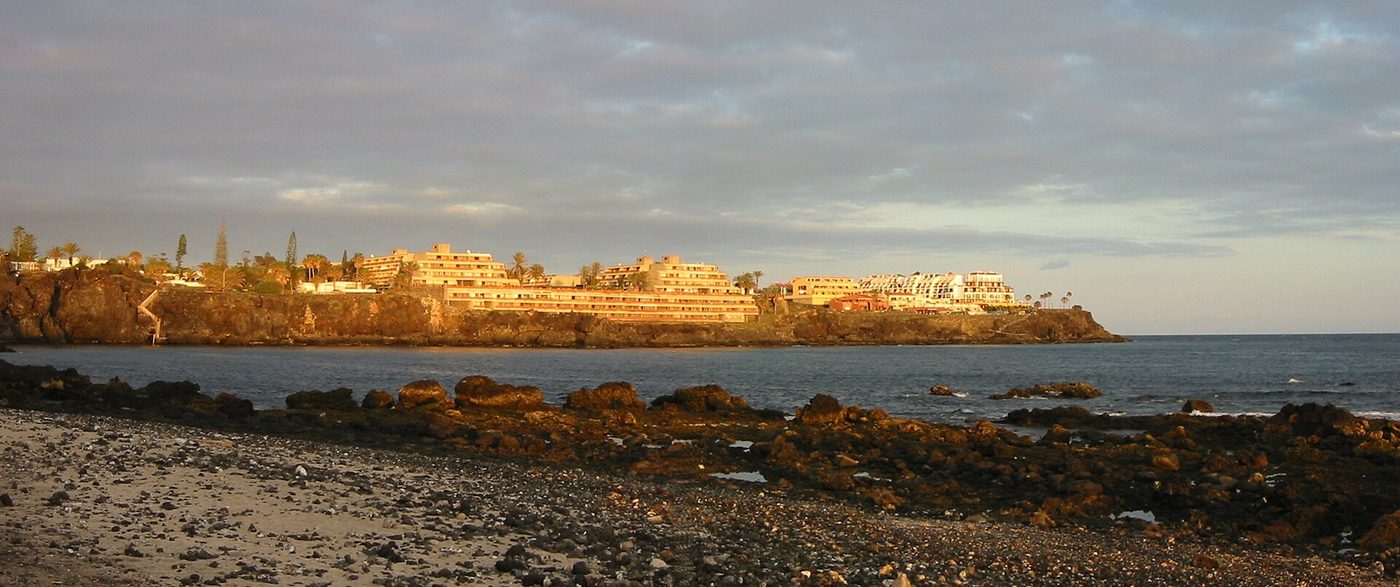
Their idea was the opposite of a carpet of hotels. Buildings were grouped in separate, self-contained clusters no more than two storeys high, divided by stretches of untouched lava and native scrub; cars and pedestrians were kept apart, and a footpath of local stone followed the cliff top. The first group, Bellavista, with 14 villas and 34 bungalows, was built in 1964, and the clusters that followed over some twenty years, Carabela, Drago, Eureka, Frontera and others, became a laboratory of tourist architecture that was later held up as a model of building in harmony with the Canarian landscape.5 The architects themselves regretted that much of the natural ground they had protected was spoiled in later years.5
Village and resort
Arona's general plans of 1966 and 1987 set the coast aside for tourism, with Las Américas, Los Cristianos, Palm-Mar and the Costa del Silencio as its main zones, and the 1994 plan kept further land around Costa del Silencio and Las Galletas in reserve.6 Las Galletas itself grew from a handful of houses into a small town of apartments and seafront cafés, still with its fishermen's beach and a marina beside the old harbour. Behind it the malpaís of Rasca, with its lighthouse and salt pans, remains one of the few stretches of this coast that looks much as the first settlers knew it.36
Notes and sources
- 1.A. Mederos Martín and G. Escribano Cobo, "Prospección arqueológica de La Caleta de Adeje (Tenerife, Islas Canarias)", Revista de Historia Canaria 198 (2016), pp. 177-229 (section on the borders of the menceyato of Adeje and the land grant of 1516). riull.ull.es
- 2.A. Mederos Martín, G. Escribano Cobo and V. Valencia Afonso, "Poblamiento aborigen y grabados rupestres en el municipio de Arona (Tenerife, islas Canarias)", Anuario de Estudios Atlánticos 68 (2022), 068-002, pp. 1-80 (Rasca salt pans, radiocarbon dates, sites around Las Galletas). revistas.grancanaria.com
- 3.Cabildo de Tenerife, Patrimonio Histórico de Tenerife. Catálogo de Bienes de Interés Cultural, 2018 (entry for the archaeological zone of La Rasca). tenerife.es
- 4.M. M. Chinea Oliva, "Las bases sociales del poder local. Algunos apuntes para su estudio en Arona (sur de Tenerife), 1900-1936", XIV Coloquio de Historia Canario-Americana (2000). revistas.grancanaria.com
- 5.Materia contemporánea. Javier Díaz-Llanos y Vicente Saavedra. 50 años de arquitectura, exhibition catalogue, TEA Tenerife Espacio de las Artes, Cabildo de Tenerife (introductory essay, interview with the architects and entries for the Costa del Silencio plan and Ten Bel). teatenerife.es
- 6.C. García-Blanco Chávez, "Turismo y territorio. La transformación del sur de Tenerife (1960-2018)", Territorios en Formación 23 (2025), DOI 10.20868/tf.2025.23.5625. polired.upm.es
What's on in Arona now →
Fiestas, concerts and events from the town hall agenda, updated daily.
More towns in the series
La Laguna · Towns of Tenerife
San Cristóbal de La Laguna: a town planned for peace
Garachico · Towns of Tenerife
Garachico: the port the volcano took
Bajamar · Towns of Tenerife
Bajamar and Punta del Hidalgo: La Laguna's shore
Candelaria · Towns of Tenerife
Candelaria: the shrine on the shore
Santa Cruz de Tenerife · Towns of Tenerife
Santa Cruz: from army camp to capital
La Orotava · Towns of Tenerife
La Orotava: a town drawn with a cord
Adeje · Towns of Tenerife
Adeje: the kingdom, the fortress and the marquises
La Caleta · Towns of Tenerife
La Caleta: Adeje's old harbour
Los Cristianos · Towns of Tenerife
Los Cristianos: the south's harbour
Playa de las Américas · Towns of Tenerife
Playa de las Américas: a resort from scratch
Callao Salvaje · Towns of Tenerife
Callao Salvaje: a resort by decree
Playa Paraíso · Towns of Tenerife
Playa Paraíso: a paradise on paper
Guía de Isora · Towns of Tenerife
Guía de Isora: from Teide to the sea
Playa San Juan · Towns of Tenerife
Playa San Juan: Guía de Isora's harbour
Alcalá · Towns of Tenerife
Alcalá: a fishing village on the lava
Puerto Santiago · Towns of Tenerife
Puerto Santiago and Los Gigantes: life below the cliffs
El Médano · Towns of Tenerife
El Médano: the harbour under the red mountain
Icod de los Vinos · Towns of Tenerife
Icod de los Vinos: the dragon tree and the cove of San Marcos
Puerto de la Cruz · Towns of Tenerife
Puerto de la Cruz: from wine port to the first resort
San Juan de la Rambla · Towns of Tenerife
San Juan de la Rambla: a village on the badlands
Buenavista del Norte · Towns of Tenerife
Buenavista del Norte: a planned town at the end of the island